
Good or bad by which school?
"Good Feng Shui" means different things depending on who is reading the house.
- Form school reads the shape of the plan and what you see from the door: the entrance, the path through the home, where the furniture stands. It is the most visible part of the practice and the easiest to check yourself.
- Compass schools such as Eight Mansions read the direction the house faces and match it to the people in it, so a house can suit one family and not the next.
- Flying Stars adds time: the same house is read differently from year to year.
- The Bagua map reads which life areas sit where on the plan, which is why an L-shaped home is said to have a missing corner.
Most questions about whether a house "has bad Feng Shui" are really form-school questions, because they start from what someone noticed walking in. That is the reading this page follows. The others are worth knowing about so that one teacher’s warning is not taken as the tradition’s last word.
Signs of bad Feng Shui in a house layout
These are the layout signs form-school writers raise most often. Each has its own page with the traditional reasoning and the usual remedy.
- The front door lines up with a window or back door across the home, read as flow passing straight through instead of circulating. See what the front door faces.
- Stairs rising straight ahead of the front door, close enough that the stairs face the door.
- A bathroom or bedroom door in direct view of the entrance.
- A blocked entryway: furniture, shoes or a cabinet in the first step inside.
- A long hallway aimed at one door, or a corridor that ends in a blank wall.
- Beds and desks out of the command position: a bed facing the door in line with it, or a desk with its back to the room.
- Sharp corners of furniture pointing at the bed, sofa or desk.
- Rooms so full of furniture that you turn sideways to cross them.
The problems hub lists the rest, from a mirror facing the bed to a beam over it. Several of these have a plain practical side too: a cluttered entry is awkward with shopping bags, and a bed in line with the door gets the draught and the hall light.
Signs of good Feng Shui in a home
The good signs are mostly the same list read the other way round. Form-school practice tends to favour:
- An entrance that opens into space, with room to stand, take off a coat and see into the home before the next door.
- A path that bends gently from the front door through the living rooms, rather than one straight line to the back or a maze of narrow gaps.
- Private rooms further in. Bedrooms and bathrooms away from the front door; living space near it.
- Every room easy to reach without passing through another one.
- A bed and a desk that can see the door from a solid wall, and a sofa with its back to a wall instead of to the room.
- A simple overall shape, a rectangle or square, so the Bagua map has no gaps.
None of these makes a home lucky in the tradition’s own terms. They describe a house where the reading turns up little to attend to. The whole-home guide covers how the rooms are expected to connect.
Fixed or movable: what you can do about it
Sorting what you notice into two piles changes the answer more than anything else. Movable signs are furniture, mirrors, clutter and rugs: a sofa across the entry is a bad sign today and gone this evening. Fixed signs come with the walls: a door lined up with a window, stairs facing the door, a bathroom off the entrance, a missing corner.
For movable signs, tradition’s remedy is to move the thing. For fixed ones, the remedies are softer and symbolic. A plant, screen or rug breaks a straight line; good light and a rug soften stairs; a closed door and a runner turn the eye from a bathroom. Teachers present these as ways of living with a layout, not as repairs.
So "what happens if you have bad Feng Shui?" has a traditional answer and a practical one. The tradition says the affected area of life is weaker until it is remedied. Nothing about that has been tested, and no remedy here promises a result. The practical answer is that most of the signs are about how easily you can move around your home, which is worth fixing for its own sake. If you are looking at a house you might buy, the viewing checklist applies the same sorting to a home you cannot yet rearrange.
How the Flow score reads a home
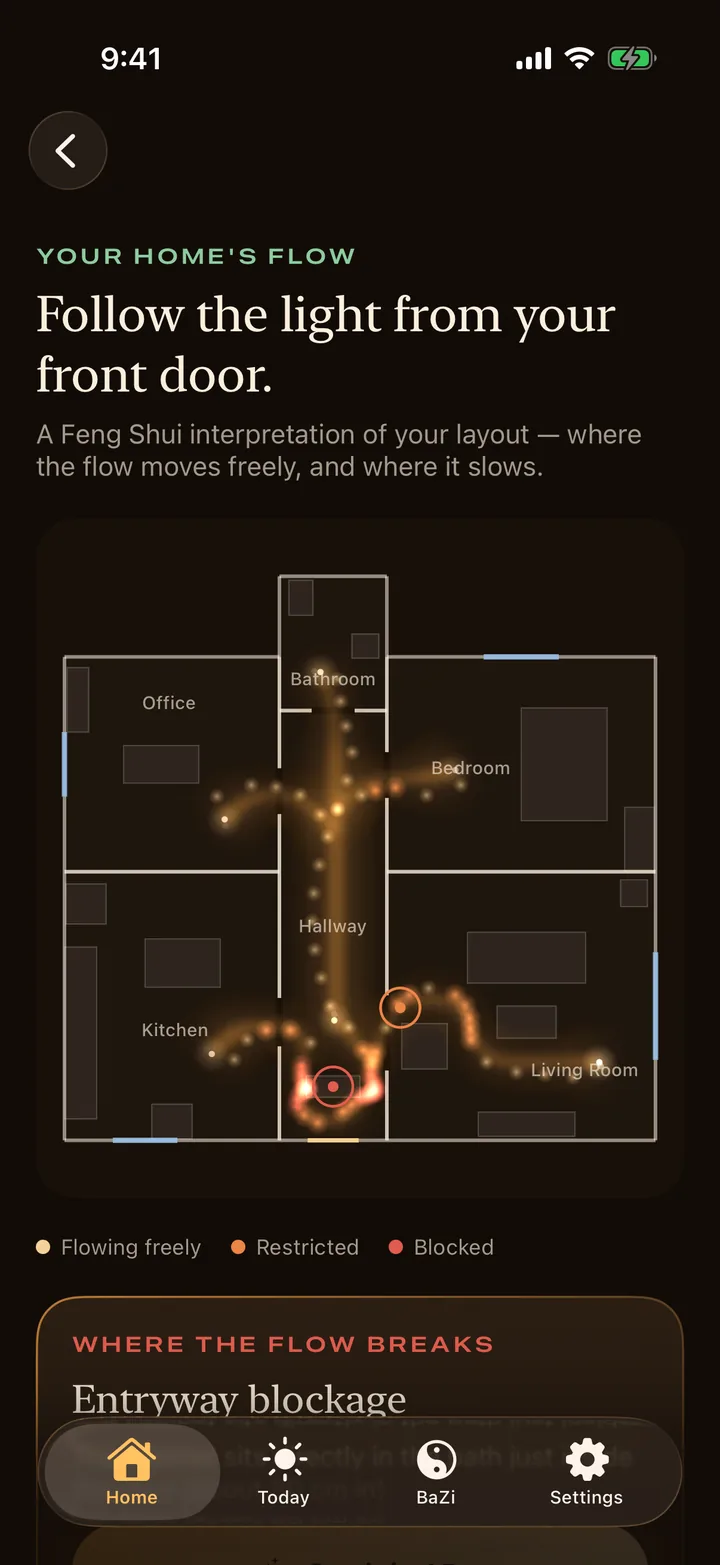
Feng Shui AR turns one form-school reading into a number. After you walk the home from the front door, it draws the floor plan, traces the flow path from the door through each room, and gives a Flow score out of 100 built from five parts:
| Part | Weight | What lowers it |
|---|---|---|
| Entrance Flow | 25% | Furniture in the entry, a door in line with a window or back door, a door facing a bathroom, a bedroom or the stairs |
| Circulation | 25% | Narrow passages, crowded rooms, dead-end hallways |
| Flow Continuity | 20% | How much of the path is squeezed or cut, and how many places it happens |
| Room Connectivity | 15% | Rooms the path cannot reach |
| Furniture Placement | 15% | Furniture in the path, a mirror facing the door, sharp corners at a bed, sofa or desk, beds and desks out of the command position |
Each finding takes points from its part according to how serious the app rates it. A home with nothing flagged and every room reached scores 100 or very close. A single finding usually costs between two points and a little over a dozen; the larger losses come from furniture that blocks the path, which counts against two parts at once. There is no pass mark and no label saying good or bad: you get the number, the five parts, the findings behind them and a potential score for the moves Optimize My Home suggests.
What the score leaves out
The score is a reading of how the home is laid out from the front door. Many things people search for under "bad Feng Shui house" are not in it:
- A missing corner. The app lays the Bagua over the plan and lists any area with less than half its square on your floor as missing, but that list is separate. A missing corner does not lower the Flow score.
- Direction and timing. The compass heading recorded during the scan is used for the compass view and for where beds and desks sit against your BaZi chart. It does not change the score, and Eight Mansions and Flying Stars are not read.
- Location and numbers. A road running straight at the door, a house at the end of a T-junction, or the number 4 in the address (it sounds close to the word for death in Mandarin and Cantonese) are things some buyers weigh. None of them are read.
- Upper floors, beams, clutter, colours and light. In a multi-storey home the score comes from the floor with the front door.
A high score means the form-school layout rules the app applies found little to point at. It is not a verdict on the house, its value or the people in it.
Four homes, read the Feng Shui way
- A flat where the front door opens onto a sofa back — A strong sign on paper and the easiest to fix. Turn or slide the sofa so there is a clear step inside the door, and the reading changes with it.
- A terraced house with the stairs a metre from the door — Fixed. Tradition reads it as a concern; the remedies are a rug at the foot of the stairs, a plant to one side and good light. The rest of the house may read well.
- An L-shaped bungalow with an open, easy layout — The form-school signs are few, but the Bagua shows a missing corner. Two schools, two answers about one house. Pick the reading you trust and stay with it.
- A family home with every bedroom door off one long corridor — The corridor and the dead end at its far wall are fixed. A runner, art at the end wall and light along the way are the usual softening moves.
Common mistakes
- Calling a house bad for something you can move — clutter, a mirror or a sofa across the entry is a weekend’s work.
- Adding up signs from different schools — a missing corner, a compass direction and a stairs warning come from different readings and do not stack into one score.
- Treating a score as a verdict — a number out of 100 shows how one set of layout rules sees the plan, nothing more.
- Fixing everything at once — start with the entrance, where both the tradition and daily life notice most.
What a scan shows about your home
- A Flow score out of 100 from five parts: Entrance Flow, Circulation, Flow Continuity, Room Connectivity and Furniture Placement.
- The findings behind it, each placed on your floor plan: blocked entry, a door in line with a window, an entrance facing a bathroom, bedroom, mirror or stairs, narrow passages, crowded rooms, dead ends, rooms the path cannot reach, sharp corners, and beds and desks out of the command position.
- Optimize My Home: furniture moves tested against the whole analysis, each with the score that layout would get, and a rescan to see the change.
- The Bagua map with any missing areas, and a compass view, shown beside the score but not counted in it.
- Not read: location, house numbers, Eight Mansions or Flying Stars, beams, clutter, colours, light, and floors above or below the front door.
Questions
How do I know if my house has good Feng Shui?
Start at the front door. If you can step inside without turning sideways, the door does not look straight through to a window or the stairs, the path into the living space is easy, and your bed and desk can see the door, form-school Feng Shui would find little to remedy. Other schools may still read the direction or the Bagua differently.
What are the signs of bad Feng Shui in a house?
The most commonly cited are a front door in line with a back door or window, stairs straight ahead of the door, a bathroom in view of the entrance, a cluttered entry, long corridors, and beds or desks that cannot see the door. Most writers treat these as things to remedy, not reasons to leave.
What happens if you have bad Feng Shui?
In the tradition's terms, the area of life a sign is linked with is said to be weaker until it is remedied. There is no evidence for those effects. The practical side is that many of the signs make a home harder to move through, which is reason enough to fix the movable ones.
Can a house with bad Feng Shui be fixed?
Most layout signs are furniture and can be moved. Fixed ones, such as stairs facing the door or a door lined up with a window, are softened rather than removed, with plants, screens, rugs and light. Teachers present these as symbolic remedies.
Does the Flow score count a missing corner?
No. The Bagua map and its missing areas are shown separately. The score comes from how you move through the home from the front door and where the furniture stands, so a missing corner does not lower it.
Are some house numbers bad Feng Shui?
Some buyers avoid the number 4 because it sounds close to the word for death in Mandarin and Cantonese, and some favour 8. It is a cultural preference rather than a layout reading, and the scan does not consider it.
Sources and further reading
- Guo Pu (attributed), 葬書 Zangshu (The Book of Burial), Jin dynasty, 4th century
- Ole Bruun, An Introduction to Feng Shui, Cambridge University Press, 2008
- Michael Paton, Five Classics of Fengshui: Chinese Spiritual Geography in Historical and Environmental Perspective, Brill, 2013
Works on the tradition this page summarises. They are further reading, not endorsements of the app. How the app applies the rules: how Feng Shui AR reads a home.
Reading a list of signs is easy. Seeing which of them your own home has, and which you could clear this week, is the useful part.
SEE YOUR HOME'S SCORE
Walk your home from the front door and get a Flow score out of 100, the five parts behind it and each finding, with moves that would raise it.
On the App Store and Google Play · iPhone, iPad and Android