
Why the tradition dislikes a beam over the bed
Form-school practitioners read a bedroom by asking what is above and behind the sleeper. A beam overhead is described in Chinese sources as "a beam pressing on the top", read as a constant weight bearing down on whoever lies under it, night after night.
Popular versions go further and map the beam to the body: over the head, it is said to bring a busy, unsettled mind; over the chest or stomach, poor health; over the feet, obstacles to getting about. A separate version concerns a couple’s bed. A beam running lengthwise down the middle, between the two sleepers, is said to divide them.
These correspondences are widely repeated and none of them can be tested. Do not read them as a forecast of your health or your marriage. The part you can take at face value is simple: most practitioners would rather a bed did not sit directly under a beam.
The practical reasons
Set the tradition aside and a beam over the bed still has things against it.
It fills your view when you lie down. Standing, a beam is part of the ceiling. Lying on your back, it becomes the nearest and heaviest line in sight. A beam that drops 30 or 40 cm from a 2.4 m ceiling looks low from the pillow.
It takes headroom. In an older house, a loft or an attic room, the space under a beam can be little more than 2 m. Getting in and out of bed, or sitting up to read, brings you closer to it.
It invites things to hang from it. A ceiling fan, a pendant light or a cabinet fixed to the beam ends up directly over the bed. That, not the beam, is the real worry. Beam edges also gather dust that a flat ceiling does not.
So even if you take none of the tradition on board, the strip of floor under a beam is often the worst place in the room for the bed.
How to judge how serious yours is
Beams are not all equal. Work through these in roughly the order a practitioner would.
- Is it over the bed at all? A beam that passes beside the bed, clear of it, is not counted by most practitioners.
- Which part of you does it cross? Lie down and see whether it falls over your head, your middle or your feet. Over the head is taken most seriously, over the feet least.
- Across or along? A beam crossing the bed is read differently from one running along its length down the middle, which is the one tied to the couple’s-bed version.
- How low and how deep? A beam that drops 10 cm and one that drops half a metre are different things from the pillow. The closer it comes to the mattress, the more weight it gets.
- Structural or decorative? Exposed timber beams high in a pitched or vaulted ceiling are shrugged off by some practitioners and treated like any other beam by others.
The test that settles most of this is to lie down with your head on the pillow and note where the beam falls and how close it feels.
Remedies, by effort
Free
- Move the bed. Every school accepts this one. Clearing the beam entirely is best; if you cannot, shifting the bed 30 to 50 cm so the beam passes beyond the foot rather than over the head reduces the problem to its mildest form. Check the new spot with the bed placement tool so you still see the door.
- Turn the bed around. If the beam sits near one end of the room, putting the headboard on the opposite wall turns a beam over the head into one over the feet.
- Take down what hangs from it. Move a fan or cabinet that is fixed above the bed.
Small spend
- Paint the beam the ceiling colour. A dark beam reads as heavier and lower; painted to match, it recedes into the ceiling.
- A canopy or bed curtain. A fabric top over the bed means you look up at cloth, not at the beam. It is an old remedy that still works.
If you are renovating
- Box the beam into a flat ceiling. This is the remedy most often used in Chinese homes. It costs ceiling height, so dropping only the strip under the beam, or easing it with a curve or slope, is the usual compromise.
- Never cut into the beam itself. A structural beam is not something to notch or shave. Anything that touches it is a job for someone qualified to judge the structure.
Where the schools disagree
The form school and most popular advice take a beam over the bed seriously. Compass-school (Li Qi) practitioners care more about the bed’s direction and sector, and say less about beams, though few dismiss them outright.
Hung remedies divide people most. A pair of bamboo flutes tied to the beam, or a gourd, is a Black Hat and folk remedy. Many classically trained practitioners say no ornament replaces moving the bed or hiding the beam, and some never use them. If you hang one, make sure it is fixed well enough that it cannot fall on the bed.
The other disagreement is about decorative timber beams in newer homes. Some say a non-structural beam high up does not count; others treat every beam alike. There is no settled answer.
Don’t trade away the door to escape a beam
The most common mistake is moving the bed somewhere worse: feet pointing out of the door, the headboard under a window, or your back to the door. In Feng Shui those rules are held more widely than the beam rule.
Keep the command position first (a view of the door, out of its direct line, a solid wall behind the headboard) and avoid the beam within that. The bedroom layout page explains the command position, and bed facing the door and bed under a window each have their own page. If the room is so small that every spot is a trade-off, see small bedroom Feng Shui. A beam over a desk follows the same logic; see the home office.
Bedrooms with a beam
- A large beam across the middle of the main bedroom — It falls over the centre of the bed. Sliding the bed toward the wall opposite the door, or moving the headboard to another wall, usually puts the beam beyond the foot. If both choices would leave the bed facing the door, keep the door position and box in a strip of ceiling instead.
- A beam running along the headboard wall — It sits right over the pillows. Pull the bed 40 to 50 cm into the room and put a low cabinet between the headboard and the wall, so the beam lands over the cabinet rather than your head.
- Timber beams under a sloping attic roof — Several beams, uneven heights. Put the bed under the highest section and clear of the lowest beam; light paint and a canopy help most here.
- A small room with no choice — The bed can only go under the beam. Paint it the ceiling colour, add a canopy, make sure nothing hangs from it, and stop worrying about it.
Common mistakes
- Judging it standing up — What matters is where the beam falls and how close it is once you lie down. You cannot tell from the doorway.
- Turning the bed to face the door to escape it — That swaps one disputed rule for an arrangement more people object to.
- Hanging things over the bed — A fan, a cabinet or a heavy ornament fixed to the beam above the bed is a real hazard.
- Cutting the beam — Box it in, never shave it. A structural beam stays as it is.
- Treating an ornament as the whole fix — Schools disagree about flutes and gourds; if the bed can move, move it first.
Whether a beam crosses your pillow is something you can see by lying down. What is harder to judge by eye is how the bed stands against the door, the walls and the window once you have moved it out from under the beam. That is the part a scan does.
SCAN YOUR BEDROOM
A scan does not read beams, but it draws the room and checks the bed against the door, the wall and the window, so you can move it out from under one.
On the App Store and Google Play · iPhone, iPad and Android
What a scan reads here, and what it doesn't
- The app draws the room’s walls, doors, windows and furniture. Ceiling beams are not part of it; it does not know where yours is.
- It checks the bed’s command position: can you see the door, are you in its direct line, is the headboard on a solid wall and not under a window.
- A sharp furniture corner aimed at the bed.
- How much of the floor furniture covers, and whether it narrows the route through the room.
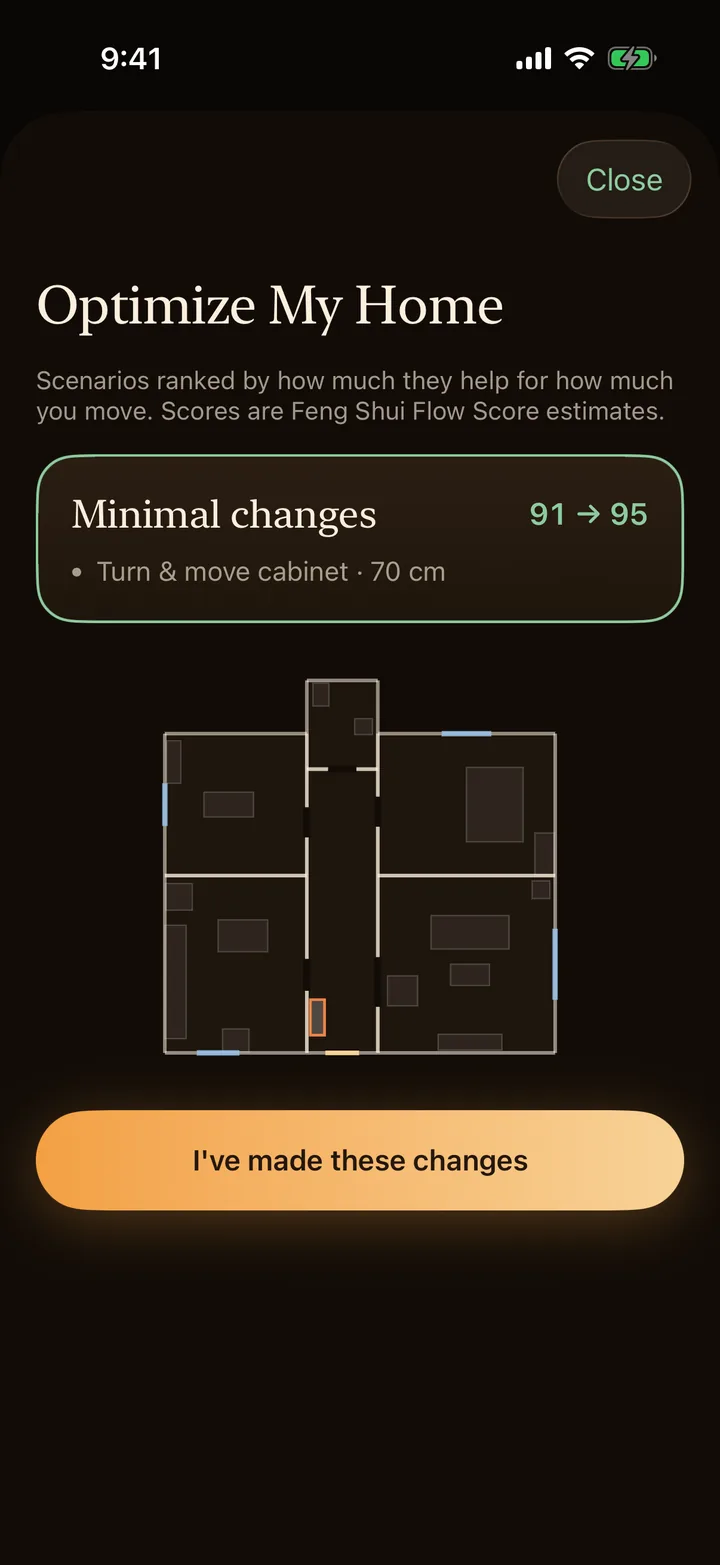
- The bed moves "Optimize My Home" suggests do not take beams into account. Check there is no beam over a suggested spot before you use it.
- Not read: ceiling beams, ceiling height, anything hanging from a beam, or what sits above what. Lie down and look for those yourself.
Questions
Does a beam over the bed always need fixing?
The tradition treats it as worth fixing, but beams vary a great deal. Most practitioners would move the bed or box in a deep beam that crosses the head close to the mattress. Many would leave a shallow beam that only passes over the foot.
Is a beam over the head worse than one over the feet?
Yes. Almost every version ranks the head as the most serious position and the feet as the least. If you can only shift the bed a little, moving the beam from the head to beyond the foot is the step that does the most.
Does a beam still count once it is boxed into the ceiling?
Most practitioners say no. Once it is hidden in a flat ceiling you look up at a level surface, which is why boxing in is the standard remedy. A stricter minority holds that the beam is still there.
Do bamboo flutes or a gourd on the beam work?
They are a Black Hat and folk remedy, and the schools disagree about them. Many practitioners say they do not replace moving the bed or boxing the beam. If you hang them, make sure they are fixed securely.
Can Feng Shui AR detect a ceiling beam?
No. The app maps walls, doors, windows and furniture, not ceiling beams or ceiling height. What it can do is check a new bed position once you have moved the bed out from under the beam: whether you see the door, whether you are in its line, and whether the headboard is on a solid wall.
Sources and further reading
- Guo Pu (attributed), 葬書 Zangshu (The Book of Burial), Jin dynasty, 4th century
- Ole Bruun, An Introduction to Feng Shui, Cambridge University Press, 2008
- Michael Paton, Five Classics of Fengshui: Chinese Spiritual Geography in Historical and Environmental Perspective, Brill, 2013
Works on the tradition this page summarises. They are further reading, not endorsements of the app. How the app applies the rules: how Feng Shui AR reads a home.