
Two situations, not equally serious
"Bedroom door facing the bathroom door" usually means one of two layouts.
A bedroom door and a bathroom door facing each other across a hall. Open the bedroom door and you look at the bathroom door. The tradition files this under doors facing doors, with the bathroom side singled out because the bathroom is where water and flow leave the home. Most practitioners consider it dealt with once the bathroom door is kept shut. For interior doors facing each other in general, see door facing door.
An en-suite door facing the bed. The bathroom opens off the bedroom itself, through a wall the bed can see, sometimes straight at the foot of the bed. This is taken much more seriously: there is no hall and no second door between the bed and the bathroom. The arrangement liked least is a bed directly in line with the bathroom door, with your feet toward it as you lie down.
A third case is often asked about at the same time: seeing the toilet from the bed through an open bathroom door. Where the toilet sits is covered on the bathroom page, and the same reasoning applies here.
The practical reasons
The rule has lasted because its practical side is more persuasive than its symbolism.
- Smell. The nearer the bathroom and the more often its door is open, the more easily smells reach the bedroom, especially where ventilation is poor.
- Damp. Steam from a shower rolls out of the doorway and settles first on whatever is nearest. Mattresses, headboards against the wall and clothes in a wardrobe all suffer from steady damp.
- Noise. A flush, an extractor fan or a boiler firing at night is loudest for whoever sleeps nearest the door.
- Light. When one person gets up in the night and switches on the bathroom light, it falls across the bed and wakes the other.
All four are sharpest with an en-suite, where nothing stands between the two doors. So even if you give the tradition no weight, a closed bathroom door and a bed out of its line are sensible.
How to judge your room
You cannot judge it from the doorway. Check from two places.
- Lie down, on both sides of the bed. Open the bathroom door and see whether you can see into the room, and whether you can see the toilet.
- Check whether the bed is in the door’s line. Draw a line from the bathroom doorway toward the bed. If it runs along the bed’s length, the bed is in line with that door, which is the case given most weight.
- Notice whether the door is usually open. A door that stands open and a door on a closer that is always shut are different things to every practitioner.
- Check what is behind the headboard wall. Some practitioners also raise a bathroom directly behind the wall the headboard rests on. It is not a door issue, but it often comes with one.
Remedies, by effort
Free
- Keep the bathroom door closed. The most common advice of all, and it answers smell, damp, noise and light at once.
- Keep the toilet lid down. Tradition and hygiene agree.
- Use a night light. A dim light in the bathroom means no one needs the main light at night.
- Run the fan and open the window after a shower. Let the steam leave through the bathroom, not through the door into the bedroom.
Small spend
- A door closer or rising hinges. The easiest answer when someone always forgets to shut the door.
- A door curtain. A fabric curtain hung outside the bedroom or bathroom door breaks the view between the two. It is one of the most common remedies in Chinese homes.
- A draught seal along the bottom of the door. It cuts smells and light from the gap.
- A screen or a low cabinet. Placed between the bed and an en-suite door, it breaks the line between them.
- Film on a glass partition. Many en-suites are walled in glass; frosted film, or a curtain on the bed side, deals with it.
Rearranging
Move the bed so it is out of line with the bathroom door, but not at the cost of your view of the bedroom’s main door or the solid wall behind the headboard. The bed placement tool lets you try a few positions.
Which door counts?
A bedroom with an en-suite has two doors, which complicates the command position. Traditionally the command position is judged by the bedroom’s main door, as the bedroom layout page explains. The bathroom door is a separate matter: keep it shut and stay out of its line.
The awkward case is when moving the bed to see the main door puts it straight in line with the bathroom door. Practitioners do not agree on how to weigh the two. A common view is that a bathroom door can be kept closed more easily than a main door can, so when the two conflict some favour the main door and keep the bathroom shut. Others insist on meeting both, even if the bed has to change walls. For the bed and the main door, see bed facing the door.
Where the schools disagree
Beyond closing the door, advice varies.
Black Hat teachers often suggest a full-length mirror on the outside of the bathroom door to turn the home’s flow away. Many classically trained practitioners do not use it, and some object, because a mirror on an en-suite door tends to face the bed, which is another common caution; see mirror facing the bed. If you try it, lie down first and see what the mirror shows.
Compass-school practitioners care more about which sector of the home the bathroom falls in than about what its door faces. The form school looks at doors, lines and what you can see from the bed. They are not two answers to the same question, and there is no need to force them together.
Layouts that come up often
- Bedroom and bathroom doors face each other at the end of a hall — With both doors open, you may see straight into the bathroom from the bed. A closer on the bathroom door and a curtain outside the bedroom door settle most of it.
- An en-suite door facing the foot of the bed — You lie with your feet toward the bathroom. Slide the bed along the headboard wall so the door ends up diagonally across from it; if it cannot move, put a low cabinet or a screen between the foot of the bed and the door.
- A glass-walled en-suite — You can see everything inside from the bed, and its light falls straight into the bedroom. Frosted film, or a curtain track on the bed side, deals with both.
- A small flat where the bathroom door is beside the headboard — The door opens in the same wall the bed rests on. Keep it closed, use a night light, and if the room allows, move the headboard to the solid wall opposite.
Common mistakes
- Checking only in daylight — Light and noise are night problems. Lie down with the lights off and look again.
- Hanging the curtain on the wrong side — It should block the line of sight from the bed into the bathroom; check which side does that before you hang it.
- Turning your back to the main door to escape the bathroom door — That trades an easy problem for a harder one.
- A mirror on the en-suite door without checking what it shows — It very easily ends up facing the bed.
- Writing off a closed door as superstition — A shut door deals with smell, damp, noise and light. It is the piece of advice that asks you to believe least.
What the bathroom door faces, you can see by lying down. How the bed stands against the nearest door is harder to judge in a bedroom with two doors, and that is the part a scan does.
SCAN YOUR BEDROOM
Map your bedroom with your phone and see where the bed stands against the nearest door, the wall behind it and the window.
On the App Store and Google Play · iPhone, iPad and Android
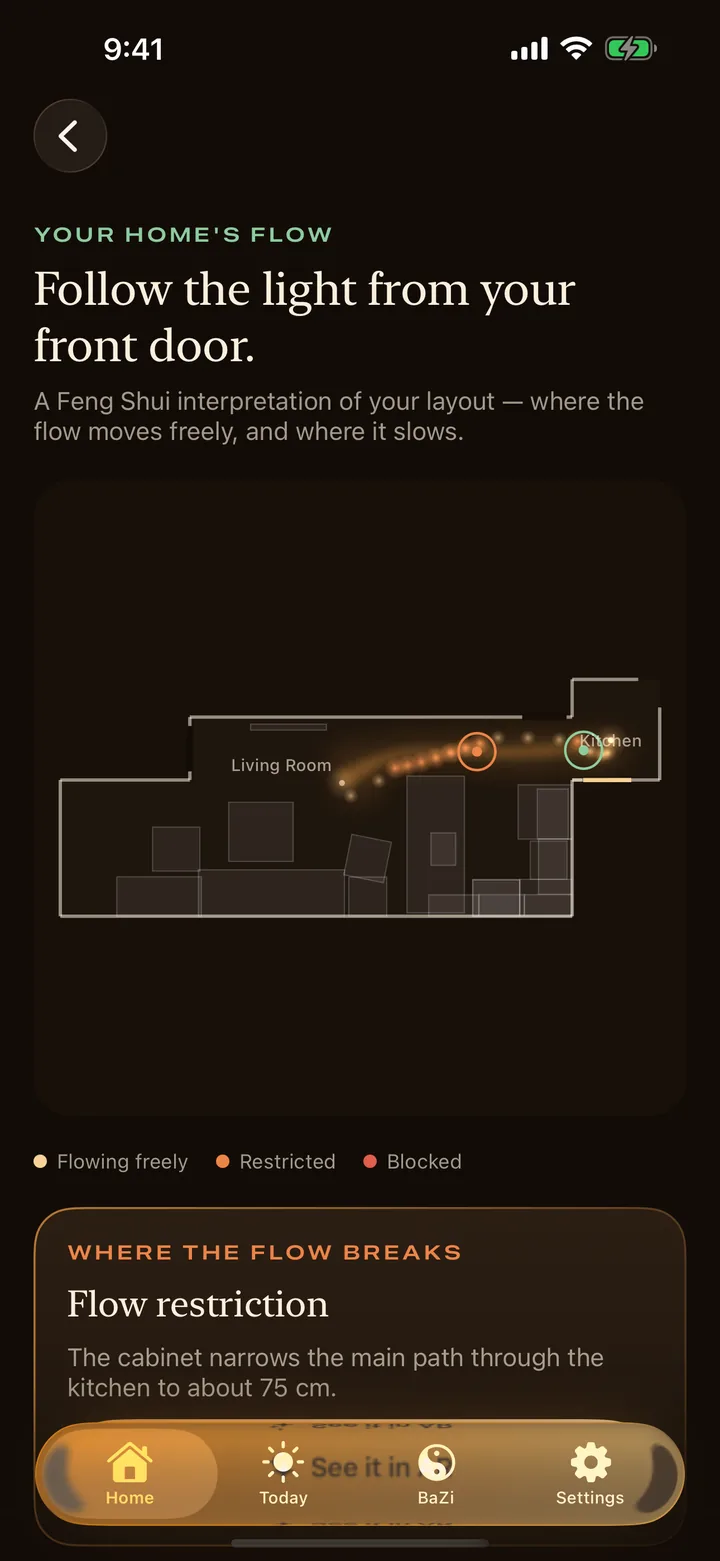
What a scan reads here, and what it doesn't
- The bed’s command position. The app checks the bed against the door of the room nearest to it: can you see it, and are you in its direct line. In a bedroom with an en-suite, that door may be the bathroom door.
- Whether the headboard is on a solid wall, and whether it sits under a window.
- A straight view from the front door to a bathroom door, which applies to the home’s front door only.
- A sharp furniture corner aimed at the bed, and furniture narrowing the route through the room.
- Not read: a bedroom door and a bathroom door facing each other across a hall, whether a door is usually kept closed, where the toilet sits in the bathroom, smell or damp. Those you check yourself.
Questions
Is a bedroom door facing a bathroom door always bad Feng Shui?
The tradition dislikes it, but most practitioners consider doors facing across a hall dealt with once the bathroom door is kept closed. An en-suite door facing the bed is taken more seriously.
What should I do if the en-suite door faces the foot of my bed?
Keep the door closed first; a door closer makes that automatic. If the bed can move, put it diagonally across from the bathroom door. If it cannot, a low piece of furniture or a screen between the foot of the bed and the door breaks the line.
Does a door curtain help?
Yes, and it is one of the most common remedies. It blocks the view from the bed into the bathroom and cuts the light at night. Hang it on the side that blocks that view.
Can I hang a mirror on the bathroom door?
It is a Black Hat remedy and the schools disagree about it. On an en-suite door the mirror often faces the bed, which is another common caution. If you hang one, lie down first and check what it reflects.
Does Feng Shui AR check a bedroom door facing a bathroom door?
It does not check two interior doors facing each other. It checks the bed against the door nearest to it, which in a bedroom with an en-suite may be the bathroom door, and it flags a bathroom door seen straight from the front door.
Sources and further reading
- Guo Pu (attributed), 葬書 Zangshu (The Book of Burial), Jin dynasty, 4th century
- Ole Bruun, An Introduction to Feng Shui, Cambridge University Press, 2008
- Michael Paton, Five Classics of Fengshui: Chinese Spiritual Geography in Historical and Environmental Perspective, Brill, 2013
Works on the tradition this page summarises. They are further reading, not endorsements of the app. How the app applies the rules: how Feng Shui AR reads a home.