
Step one: get the plan the right way round
Start with a drawing of the whole home: a sales plan, a sketch on squared paper, or the outline from a rental listing. It does not need to be beautiful, but the walls should be roughly in proportion.
Mark three things on it before any grid goes down:
- The front door. In an apartment, this is the door of your own unit. The entrance of the building, the lobby and the lift do not count, because the grid covers only the home you live in.
- The outline. Teachers generally include an attached garage and leave out a detached shed. Open balconies are where they divide: some count them, many do not.
- North, if the plan gives it. You need it only for the compass method.
Then draw the smallest rectangle that encloses the whole outline and divide it into three columns and three rows. A long, narrow flat gives you long, narrow squares. That is expected: the grid is stretched to the home, not drawn as nine equal squares on top of it.
The front-door method
This is the method of the Black Hat school, the version most Western books and websites teach. Turn the plan so the front-door wall is along the bottom edge and you are looking in, as you would from the doorstep.
| Left | Centre | Right | |
|---|---|---|---|
| Far row | Wealth | Fame & Reputation | Love & Relationships |
| Middle row | Family | Health (centre) | Children & Creativity |
| Door row | Knowledge | Career | Helpful People & Travel |
The front door falls in one of the three squares of the door row, depending on where it sits along that wall. A door in the left third opens into Knowledge, a central one into Career, one on the right into Helpful People. If the door is set into an angled wall or a corner, teachers differ on which wall counts; most take the wall the door would face if the corner were squared off.
No compass is involved, so the method works the same in any building and any hemisphere. The far-left square is always the wealth corner and the far-right is always the love corner.
The compass method, and why the map gets flipped
Classical practice ties each of the eight outer areas to a direction from the centre of the home: Career north, Knowledge northeast, Family east, Wealth southeast, Fame south, Relationships southwest, Children west, Helpful People northwest, with Health at the centre. You stand near the middle of the home, take a compass reading, and divide the plan into eight wedges around that point.
This is where the flipping comes in. Chinese diagrams of the Bagua are traditionally printed with south at the top, so Fame sits at the top and Career at the bottom. Most Western floor plans put north at the top. If you lay a Chinese-style chart over a north-up plan without turning it, every area lands in the opposite direction. Instructions that tell you to "flip" the Bagua mean: turn it a half-circle so its north matches the plan’s north.
Two rules keep this straight:
- Turn, never mirror. The map is rotated, not reflected. Wealth stays clockwise of Family whichever way up you hold it. A mirrored map puts Wealth in the southwest, which no school teaches.
- Up is whatever matches your plan. In the front-door method, the door row goes against the door wall. In the compass method, the chart’s south goes to the plan’s south. There is no fixed top.
It also explains why the front-door grid looks the way it does. It is the south-up chart with the door placed at the bottom. The two methods agree only in a home whose front door faces north.
One more caution. Some printed Baguas, including those on the octagonal mirrors hung over doors, use a different arrangement of the trigrams, called Earlier Heaven. Floor-plan work uses the Later Heaven arrangement given here. You can tell them apart by what faces what: in Later Heaven the trigram of Fire (a broken line between two solid ones) sits opposite Water, while a chart that puts three solid lines opposite three broken ones is Earlier Heaven.
Reading the map
Each square stands for a part of life, an element and a set of traditional colours. Reading the map means noticing which room, or part of a room, falls in each square, and how that space is used. A Wealth square that holds the recycling bins, or a Health square that is a storeroom, is what practitioners look for first.
Most squares straddle a wall. That is normal. Treat the room with the largest share of a square as that area’s main room, and the rest as overlap.
Whole home or each room? Both are taught. The usual order is the whole home first, then, if you want detail, the same grid laid over a single room from that room’s own door. A bedroom’s far-left corner is then its own small wealth area. On a two-story house the entrance floor comes first, and teachers disagree about how to turn the grid upstairs.
Irregular plans and missing areas
An L-shaped or U-shaped flat leaves part of the rectangle outside the walls. Black Hat teaching reads a square that is mostly outside as missing, and one where only a small piece sticks out as an extension. Teachers draw that line in slightly different places; half the square is a common rule of thumb, and it is the one the app uses.
A missing area is a traditional reading, not a defect in the building. The usual responses are small: a light, a plant or a mirror on the wall nearest the gap, or something placed outside at the point where the corner would have been. Compass practitioners read missing sectors by direction instead, so the same flat can be missing different things in each school. Reading a floor plan covers how the outline and the flow path are judged together.
What to do with each area
Tradition’s advice is modest in scale:
- Wealth (purple, green, gold) — tidy, well lit, a healthy plant.
- Fame (red, orange) — good lighting and things you are proud of.
- Love & Relationships (pink, red, white) — pairs of objects, soft textures.
- Family (green, blue) — family photos, plants, things that grow.
- Health (yellow, earth tones) — open and uncluttered, the centre of the home.
- Children & Creativity (white, pastels) — work in progress, children’s art, round metal objects.
- Knowledge (blue, green, black) — books and a place to sit and read.
- Career (black, dark blue) — a clear path; usually this is the entrance itself.
- Helpful People & Travel (grey, white, silver) — pictures of places and of people who support you.
The colours come from each area’s element, explained under the five elements. None of it overrides layout: whether the entrance is clear and the path through the home is open is the first question in every school, and the floor plan self-check runs through it.
Four plans, mapped
- A one-bedroom flat with the door in the middle of the short wall — You enter through Career. The kitchen at the back left falls in Wealth, which practitioners usually accept as long as it is kept clean and lit. The bedroom on the far right is in Love & Relationships, a placement most teachers like.
- An L-shaped house with the garage cut out at the back right — The Love & Relationships square is mostly outside the walls and reads as missing. A light in the garden at that corner, or a mirror on the inside wall nearest it, are the usual responses.
- A north-up sales plan, used with a compass — Before laying a printed Bagua on it, check which way the chart is printed. If Fame is at the top, turn the chart a half-circle so Career faces north.
- A studio where the bed, desk and sofa share one room — The whole-home grid and the room grid are the same grid. Give each square one use where you can, and keep the door row clear.
Common mistakes
- Mirroring the map instead of turning it — a reflected Bagua puts Wealth where Relationships belongs and Family where Children belongs. Rotate it.
- Lining the grid up with the building’s entrance — in a flat, use your own front door.
- Combining both methods — taking Wealth from the door grid and Career from the compass gives a map that belongs to neither school.
- Drawing nine equal squares over an odd shape — the grid is stretched to the home’s outline, so the squares are only equal when the plan is.
- Rearranging for a square before checking the layout — a plant in the wealth corner does not offset a front door that opens onto a wall of boxes.
A grid is easy to draw over a square plan on paper. Your home has walls a few degrees off true, rooms that straddle two areas and a front door that is never quite where the sketch put it.
MAP YOUR REAL HOME
Scan your home and the app lays the Bagua over your real plan, by front door or by compass, and lists the rooms in each area.
On the App Store and Google Play · iPhone, iPad and Android
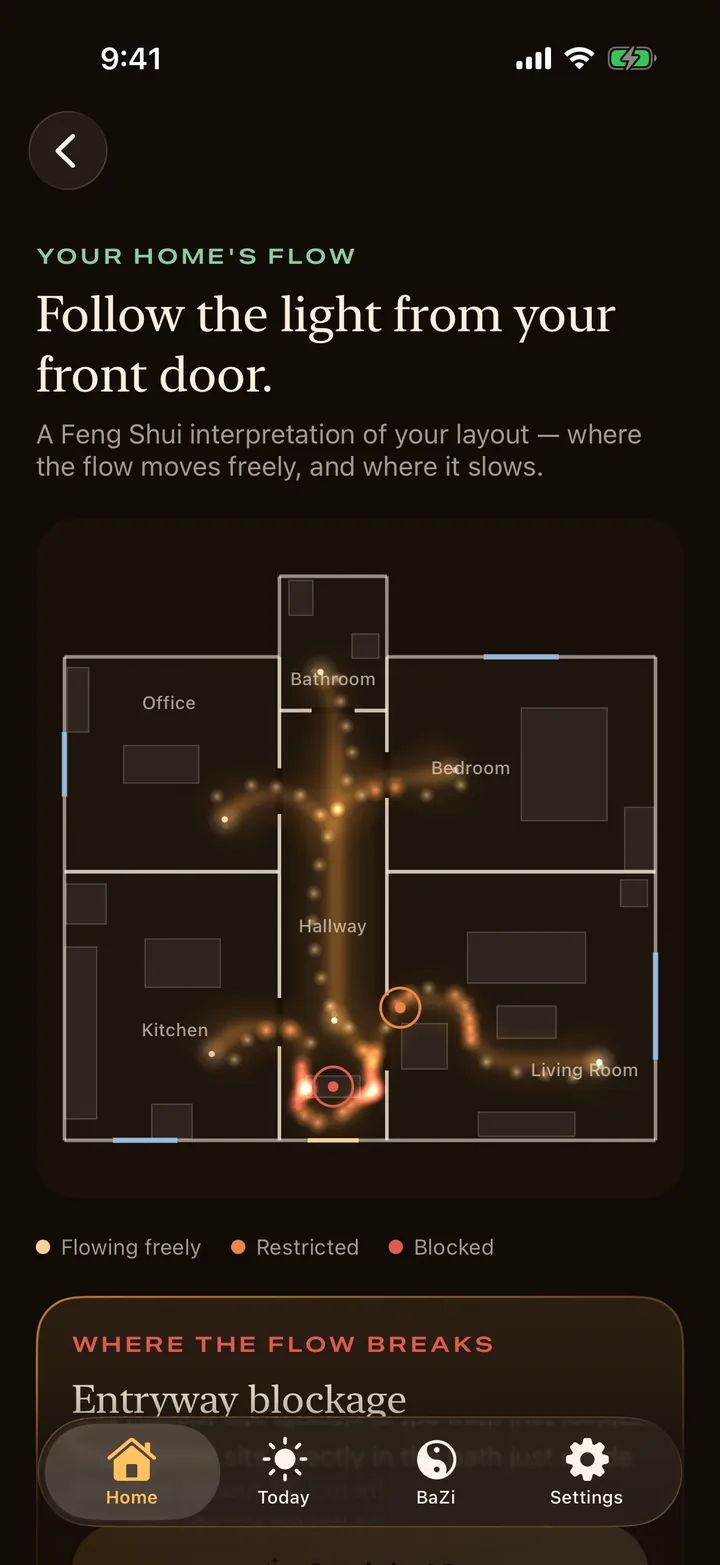
What a scan does with the Bagua
- Builds the floor plan from the home itself, by scanning or by marking corners and doorways, with the front door where it really is.
- Lays the Bagua over that plan by entrance, as a three-by-three grid stretched to the outline, or by compass, using the heading recorded during the scan.
- Shows which rooms fall mostly in which area, with each area’s element, colours and a short traditional note.
- In the entrance Bagua, lists any area with less than half of its square on your floor as missing.
- On a multi-floor home, lays the Bagua on the floor with the front door.
- Not read: what you have placed in an area or how it is decorated. The app also lays one grid over the whole floor, not a separate one inside each room.
Questions
Which way is up on a Bagua map?
There is no fixed top. With the front-door method, the row containing Knowledge, Career and Helpful People goes along the wall with the front door. With the compass method, the Fame side goes to the south of your plan, wherever that is on the page.
Why do some instructions say to flip the Bagua map?
Chinese Bagua charts are usually printed with south at the top, and most Western floor plans have north at the top. Flipping means turning the chart a half-circle so its directions match the plan's. It never means reflecting it.
Do I use the front door of my apartment or of the building?
The door of your own apartment. The grid covers the home you live in, and the shared lobby and corridors are outside it.
Should the Bagua go over the whole house or each room?
Start with the whole home, aligned to the front door or the compass. Many practitioners then apply the same grid to a single room from that room's door when they want more detail. Use the same method at both scales.
What if my front door is in the middle of the house?
With the front-door method, the door wall still goes at the bottom, and the door simply falls in the Career square. With the compass method, the door's position does not change the map at all.
Is the compass Bagua or the front-door Bagua correct?
They belong to different schools, and each holds its own to be right. The front-door method is simpler and needs no compass; the compass method is older. Neither can be tested against the other, so the useful rule is to choose one and apply it consistently.
Sources and further reading
- Sarah Rossbach, Feng Shui: The Chinese Art of Placement, Dutton, 1983
- Ole Bruun, An Introduction to Feng Shui, Cambridge University Press, 2008
Works on the tradition this page summarises. They are further reading, not endorsements of the app. How the app applies the rules: how Feng Shui AR reads a home.