
What Eight Mansions is
Ba Zhai means "eight houses". It belongs to the compass, or classical, side of Feng Shui, alongside Flying Stars, and it sits apart from the form school, which reads doors, walls and the path through a home and names no directions at all. The overview of the schools explains how they relate.
The method works with the eight trigrams of the Bagua in their Later Heaven arrangement, each tied to a compass direction. A person is given one trigram through the Kua number, and so is a building, through the direction it sits. Everything else in the system is the relationship between your trigram and each of the eight directions.
How the Kua number is calculated
The calculation uses two facts, the year of birth and sex, and one convention about when the year begins.
- Fix the year. Eight Mansions counts the year from Li Chun, the start of spring in the solar calendar, on 3, 4 or 5 February. Anyone born before it is counted in the previous year. Someone born on 20 January 1990 is calculated as 1989.
- Reduce the year to one digit. Add its four digits, then add the digits of the result until one is left. 1990 gives 1 + 9 + 9 + 0 = 19, then 1 + 9 = 10, then 1.
- Apply the rule for sex. For a man, subtract that digit from 11. For a woman, add 4. If the answer is more than 9, reduce it again.
- Replace 5. There is no Kua 5 in use, because 5 is the centre of the Luo Shu square and has no direction. The common convention reads 5 as 2 for a man and 8 for a woman.
Worked through for 1990: a man gets 11 − 1 = 10, which reduces to Kua 1. A woman gets 4 + 1 = 5, which becomes Kua 8. A man born on 20 January 1990 is counted in 1989 (digits 27, then 9) and gets Kua 2, in the other group from a man born that March.
Many guides give a shortcut using the last two digits of the year, with different constants for births from 2000 on. It gives the same numbers as the four-digit sum above; the four-digit version simply needs no century rule. Where calculators really disagree is the year boundary: some change the year on 1 January or at Lunar New Year, and give January and early-February birthdays a different Kua. The calculator on this site uses Li Chun and says when it has moved your year back.
East group and West group
The eight usable numbers fall into two groups of four.
- East group: 1, 3, 4, 9. Favourable directions are north, south, east and southeast.
- West group: 2, 6, 7, 8. Favourable directions are west, northwest, southwest and northeast.
Each group’s four good directions are the other group’s four poor ones. That symmetry is why two people in different groups cannot share a favourable direction, which matters as soon as they share a bed.
The eight directions and their names
Within your group, the directions are ranked. The four favourable ones are traditionally named Sheng Qi (vitality and success), Tian Yi (health), Yan Nian (relationships and longevity) and Fu Wei (stability and personal growth). The four unfavourable ones run from Huo Hai (mishaps) through Wu Gui ("five ghosts") and Liu Sha ("six killings") to Jue Ming ("total loss"), the one teachers treat as worst.
| Kua | Sheng Qi | Tian Yi | Yan Nian | Fu Wei | Huo Hai | Wu Gui | Liu Sha | Jue Ming |
|---|---|---|---|---|---|---|---|---|
| 1 | SE | E | S | N | W | NE | NW | SW |
| 2 | NE | W | NW | SW | E | SE | S | N |
| 3 | S | N | SE | E | SW | NW | NE | W |
| 4 | N | S | E | SE | NW | SW | W | NE |
| 6 | W | NE | SW | NW | SE | E | N | S |
| 7 | NW | SW | NE | W | N | S | SE | E |
| 8 | SW | NW | W | NE | S | N | E | SE |
| 9 | E | SE | N | S | NE | W | SW | NW |
The names are dramatic, and they are labels inside a ranking system. They describe how Eight Mansions orders a direction for one person. They are not forecasts of what follows from facing it.
Applying it: bed, desk and front door
- Bed. Most teachers take the direction the top of your head points while lying down, and aim it at one of your four good directions; Tian Yi is often suggested for sleep. A minority use the direction you face. Bed direction covers how to measure it.
- Desk. The direction you face when seated, usually toward Sheng Qi or Fu Wei. The home office page sets this against seeing the door.
- Front door. Teachers differ here. Some read the direction you face as you step out; others read which sector of the home the door sits in. Both versions compare it with the household’s favourable directions. The front door page covers what every school asks of the entrance first.
- Stove. A common rule puts the stove in an unfavourable sector with its controls facing a favourable direction; stove placement explains why teachers disagree on the details.
Every teacher who applies these adds the same proviso: direction comes after position. A desk turned to Sheng Qi with your back to the door is not counted as an improvement over one in the command position, and a desk facing a wall with the door behind is the weakest case of all.
House Kua and personal Kua
A building has a trigram too, taken from its sitting direction, the side opposite the one it faces. A house that faces south sits north, takes the Water trigram and belongs to the East group; it shares Kua 1’s map of good and poor sectors. Practitioners compare the house’s group with the occupants’ and prefer a match, then use the house map to judge which rooms sit in its stronger sectors.
Two points of disagreement run through this. Which side a building faces is not always obvious: the street side, the front door side and the side with the most light can all be different. And when a person’s Kua and the house’s Kua conflict, teachers differ on which to follow. Most give the person’s directions priority for the bed and desk, and use the house map for which rooms do what.
Limits and critiques
Eight Mansions is easy to apply, which is much of its appeal and also its main weakness. It uses only the year and sex, so everyone of the same sex born in the same solar year gets identical advice. It cannot settle a household of mixed groups except by compromise. It needs an accurate compass reading, and a phone held near a steel frame or an appliance can be off by a whole sector.
Practitioners of other compass methods also point out that Eight Mansions ignores time, which Flying Stars puts at the centre, and that it says nothing about the person’s chart beyond the year. BaZi-based approaches, such as favorable directions from the whole birth chart, start from more information and can point somewhere else entirely. The year-based element behind your Kua is also only one of several things people mean by your element. None of these methods has been shown to outperform the others, and there is no neutral test that could rank them.
Four households, worked through
- A couple, Kua 1 and Kua 8 — East and West group, so no direction suits both. A common arrangement gives one partner the bed direction and the other the desk, or favours whoever sleeps worse. Most teachers would keep the bed where it sees the door either way.
- A man born on 2 February 1990 — Born before Li Chun, so the calculation uses 1989 and gives Kua 2, West group. A calculator using 1 January would give Kua 1, East group, the exact opposite set of directions.
- A woman born in 1990 — The sum gives 5, which becomes Kua 8 by convention. Her four good directions are southwest, northwest, west and northeast.
- A desk that can only face north — For a West-group person that is a poor direction. Keeping the command position and adding a favourable direction somewhere else, such as the bed, is the usual compromise.
Common mistakes
- Using 1 January as the start of the year — for anyone born in January or early February this can put them in the wrong group, with every direction reversed.
- Reading "Jue Ming" as a prediction — the names rank directions within the system. They do not describe outcomes.
- Turning furniture away from the door to reach a good direction — every school puts position first.
- Mixing Kua directions with BaZi directions — they are different methods that often disagree. Choose one for directions and stay with it.
- Taking a compass reading next to the fridge — move away from large metal objects and take two or three readings.
A list of eight directions means little until you know which way your bed and desk really point. From inside a room most people misjudge north by one sector or more.
SEE WHICH WAY YOU FACE
Scan your home and the app records which way each bed and desk really points, so you can apply your directions to the room you have.
On the App Store and Google Play · iPhone, iPad and Android
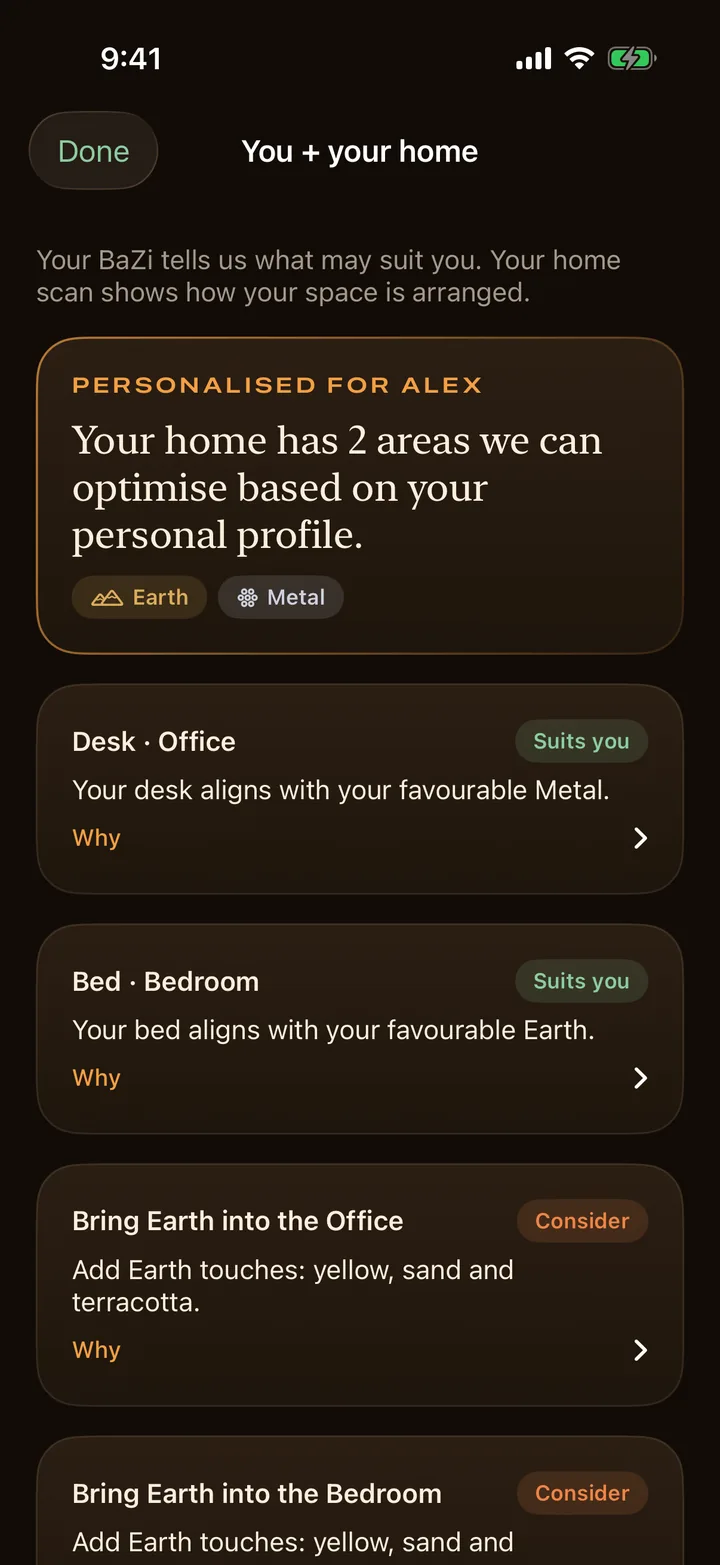
What the app does with direction
- Records a compass heading as you scan, true north where available, so each bed and desk on the plan has a real bearing.
- Notes the direction your head points in bed and the direction you face at your desk, and the sector of the home each sits in.
- Compares those with the favourable elements from your BaZi chart, not with a Kua number.
- Checks whether each bed and desk is in the command position, the rule Eight Mansions teachers put first.
- Not read: Kua numbers, East and West groups or house Kua. Use the free calculator for your number, then the app’s bearings to apply it.
Questions
How do I calculate my Kua number?
Take your birth year, moving it back one if you were born before Li Chun in early February. Add its digits down to one digit. A man subtracts it from 11 and a woman adds 4, reducing again if needed. A result of 5 becomes 2 for a man and 8 for a woman.
Why is there no Kua 5?
Five is the centre of the Luo Shu square that the eight trigrams surround, so it has no direction of its own. The usual convention treats it as 2 for men and 8 for women, both in the West group.
What is my best direction in Eight Mansions?
Sheng Qi is ranked first and is usually suggested for a desk or a front door. Tian Yi is often suggested for sleep. Which compass direction that is depends on your Kua number.
Is Eight Mansions the same as BaZi?
No. Eight Mansions uses only the birth year and sex. BaZi uses the year, month, day and hour of birth and derives favourable elements from the whole chart. They can give different directions for the same person.
Does the house Kua matter more than my personal Kua?
Teachers differ. A common approach uses the personal Kua for where you sleep and sit, and the house Kua for judging which rooms fall in the building's stronger sectors.
Sources and further reading
- Joseph Needham, Science and Civilisation in China, Vol. 4, Part 1: Physics, Cambridge University Press, 1962
- Ole Bruun, An Introduction to Feng Shui, Cambridge University Press, 2008
Works on the tradition this page summarises. They are further reading, not endorsements of the app. How the app applies the rules: how Feng Shui AR reads a home.