

Guide

Feng Shui for the Home

Feng Shui is a Chinese tradition of arranging buildings and rooms so that qi, the movement it reads in a space, can enter, circulate and settle. It is an interpretive practice with several schools that do not always agree, not a science, and nothing in it is a guarantee. For a home, the practical starting point is the front door and the route people take from it.

Download Feng Shui AR on the App StoreGet Feng Shui AR on Google Play

Updated September 30, 2026 · Traditional interpretation, not measurement or advice

BedroomLiving roomHallKitchenFront door
How form school reads a plan: one path from the front door, through each room it can reach.

What Feng Shui is, and what it is not

The name means "wind and water". The practice began with choosing sites in a landscape and was later applied to the inside of houses: where the door is, how rooms connect, where the bed and the desk stand.

It is worth saying plainly that Feng Shui is a tradition of interpretation. Its statements about qi are not established by evidence, and no arrangement of furniture promises wealth, health or luck. What keeps it useful to a sceptic is that many of its rules describe things people notice anyway: a hall you have to squeeze through, a bed with its back to the door, a room nobody goes into.

The main schools

Form school is generally regarded as the older approach. It reads shape and movement: the entrance, the route through the home, what lines up with what, and where furniture stands. It needs no compass and no birth date. The room guides here, and the app, work in this school.

Compass, or classical, school adds direction and time. Eight Mansions gives each person favourable and unfavourable directions from a Kua number based on birth year. Flying Stars charts a building from the direction it faces and the period in which it was built. Both need an accurate compass reading.

Black Hat, also called BTB, was popularised in the West in the late twentieth century. It lays the Bagua over a home lined up with the front door rather than with compass points, which makes it easy to use and is also why classical practitioners often reject it.

These schools can give different advice about the same room. Where they do, the guides say so.

Five ideas every room guide uses

  • The entrance is the mouth of qi. Tradition holds that a home takes in its flow at the front door, so what the door faces and how open the entryway is come first.
  • Flow should move without rushing or stalling. Long straight lines are said to speed it up, and blocked or crowded spaces to stop it. A whole-home walkthrough follows that route.
  • The command position. Where you sleep or work, you should see the door without being in line with it, with a solid wall behind. This decides most of a bedroom and a home office.
  • The five elements. Wood, fire, earth, metal and water, each tied to colours, shapes and directions, and related to one another in a cycle that produces and a cycle that restrains.
  • The Bagua. A map of eight life areas around a centre, laid over a floor plan either by the entrance or by compass. The Bagua map calculator lays either one over your own plan and takes you through it step by step.

Where to start: one room

Choose the room you use most, or the entry, and ask four form-school questions. Can the door open fully? Is the floor between the door and the middle of the room clear? From the main seat or the bed, can you see the door? Is there a wall behind you?

Change one thing and live with it for a week before the next. A living room usually comes down to seating, a kitchen to the stove and the working route around it, and a bathroom mostly to its door. Leave compass directions and elements until the layout is settled, since they are where the schools disagree most.
In this section

HomeFeng Shui for Your HomeHow form-school Feng Shui reads a whole home: start at the front door, follow the flow through each room, and check how the rooms line up and connect.Read →LayoutReading a Floor Plan the Feng Shui WayHow to read a floor plan the Feng Shui way: orient it at the front door, trace the flow, judge the plan's shape and lay the Bagua map over it.Read →EntranceFront Door Feng Shui: What It Should FaceWhat a front door should never face (a window, stairs, a mirror or a bathroom) and the fix for each, plus how the schools choose its direction and color.Read →EntranceFeng Shui Entryway and Entryway MirrorHow Feng Shui arranges the space inside the front door: clear floor, shoes and console, and where an entryway mirror goes and what counts as facing the door.Read →RoomsFeng Shui Bedroom LayoutWhere Feng Shui puts the bed, how it treats doors, windows and mirrors, and which rules to keep first in a small bedroom where not all of them fit.Read →RoomsFeng Shui Living Room and Sofa PlacementWhere Feng Shui puts the sofa: backed and in view of the door. Sofas under windows, floating or L-shaped, plus seating, coffee table, TV and mirrors.Read →RoomsFeng Shui Kitchen and Stove PlacementWhere Feng Shui puts the stove: in view of the door, clear of the sink and fridge. Windows, islands, stove direction, and remedies that need no plumber.Read →RoomsFeng Shui Bathroom LayoutWhy Feng Shui is wary of bathrooms, what it says about the bathroom door, toilet and mirror, and the simple remedies for a bathroom you cannot move.Read →RoomsFeng Shui for the Whole Home OfficeFeng Shui for the whole home office: window and light, storage, what shows behind you on video calls, corner desks, and a desk in a bedroom or small flat.Read →RoomsFeng Shui Bed DirectionForm-school Feng Shui names no compass direction for a bed. Eight Mansions and BaZi do, and they differ. How to measure yours and what comes first.Read →CompassEight Mansions Calculator (Ba Zhai)Free Eight Mansions calculator: set your front door direction to see your house's trigram, group and eight sectors, then add your birth date to compare.Read →Compass2027 Flying Star Chart, Area by AreaThe 2027 Flying Star chart: 9 in the centre, 5 Yellow in the north, 2 Black in the west. Where each star falls, when the year starts, and how to read it.Read →BaguaThe Feng Shui Wealth CornerThe Feng Shui wealth corner is the far-left corner from the front door, or the southeast by compass. How to find yours, and what tradition puts there.Read →BaguaWhat Is a Love Corner in Feng Shui?A love corner is the Bagua area for love and partnership: the far-right corner from your front door, or the southwest by compass. Find yours free.Read →ElementsFeng Shui Five Elements: Shapes, Colors and CyclesEach element has a Feng Shui shape: Wood tall and columnar, Fire pointed, Earth square, Metal round, Water wavy. Their colors, cycles and how to use them.Read →ElementsWhat Is My Element by Birth Year?Enter your birth date and get your element at once: Metal, Water, Wood, Fire or Earth. Born in January or February? Check the year table first.Read →LayoutFeng Shui for a Two-Story HouseHow Feng Shui reads a house on two or more floors: why the entrance floor comes first, where the Bagua goes upstairs, and what stairs and stacking change.Read →BuyingA Practical Feng Shui Checklist for Home BuyersA Feng Shui checklist for viewings: the entrance, how you move through the home, room layout, light and clutter, questions to ask, and what inspections cover.Read →

Common mistakes

  • Mixing schools without noticing — an entrance-based Bagua and a compass reading of the same home will label rooms differently. Pick one and stay with it.
  • Buying cures before moving furniture — crystals and chimes come from particular schools, while a clear path to the door is common to all of them.
  • Expecting a result — an arrangement can make a room easier to use. Tradition says more than that; nobody can promise it.

What a scan reads across your home

  • Furniture standing in the path just inside the front door.
  • Whether the front door lines up with a window or back door, a bathroom, a bedroom or a mirror.
  • Where furniture narrows or cuts the flow path, pinch points, dead-end hallways and rooms the path cannot reach.
  • Whether each bed and desk is in the command position, and sharp corners aimed at a bed, sofa or desk.
  • The Bagua laid over your plan, by entrance or by compass, and a Home Flow Score out of 100.
  • Not read: Flying Stars, Kua numbers, colours on the walls, clutter, or anything outside the building.

Questions

Is Feng Shui a science or a belief?

Neither label fits well. It is a traditional interpretive practice with its own methods and schools, and its claims about qi are not supported by scientific evidence. Many of its layout rules do overlap with ordinary sense about light, movement and privacy, which is why people who do not accept the theory still find them useful.

Which school of Feng Shui should a beginner use?

Form school is the easiest place to begin because it needs only your eyes and your floor: the door, the path, the bed, the desk. Compass methods and the Bagua can be added later. Whichever you choose, avoid combining the entrance-based Bagua with compass directions in the same reading.

Do I need a compass to start?

Not for form school, which reads what lines up with what and where furniture stands. You need one for Eight Mansions, Flying Stars and the compass version of the Bagua, and the reading has to be taken carefully for those methods to mean anything.

What is the first thing to fix in a home?

Most practitioners start at the front door: make sure it opens fully and that the floor just inside it is clear. After that, look at what the door faces across the home, and then at where the bed and the desk stand.

Sources and further reading

  • Guo Pu (attributed), 葬書 Zangshu (The Book of Burial), Jin dynasty, 4th century
  • Ole Bruun, An Introduction to Feng Shui, Cambridge University Press, 2008
  • Michael Paton, Five Classics of Fengshui: Chinese Spiritual Geography in Historical and Environmental Perspective, Brill, 2013

Works on the tradition this page summarises. They are further reading, not endorsements of the app. How the app applies the rules: how Feng Shui AR reads a home.

A guide can tell you what Feng Shui looks for. It cannot tell you what your own front door lines up with, or where the route through your home narrows. That part has to be read from the home itself.

SEE YOUR HOME'S FLOW

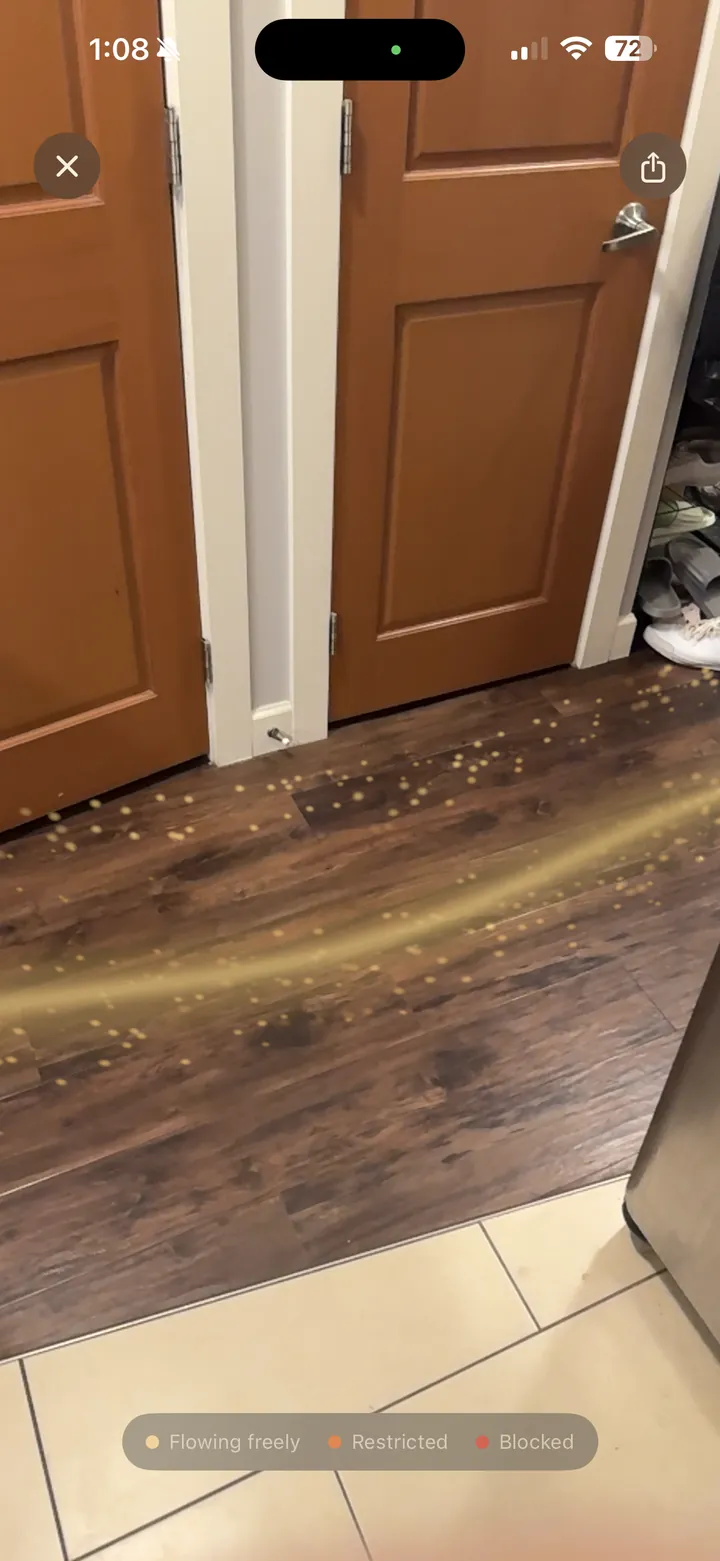
Walk your home from the front door with your phone and see the path the flow takes through it.

On the App Store and Google Play · iPhone, iPad and Android

Feng Shui AR showing the flow as moving light across a real floor in AR

Related