
Fixed or movable: the one distinction that matters
Almost every Feng Shui guide is written for people who already live in a home and want to arrange it better. Buying is different, because the parts you are paying for are the walls, doors, windows and stairs. A blocked entryway is a shoe rack you can move. A front door that opens straight onto a staircase, or a bedroom whose only free wall sits under a window, comes with the house.
So as you walk round, sort what you notice into two lists. Movable: furniture, rugs, mirrors, plants, clutter, paint, light fittings. Fixed: the position of doors and windows, the stairs, the shape of the plan, ceiling beams, where the bathrooms and kitchen are. The second list is the one a Feng Shui-minded buyer weighs; the first is a weekend’s work.
The entrance and the first few metres
Form-school Feng Shui treats the front door as the home’s mouth, and the first thing it asks is what the door looks at. Stand in the open doorway and note:
- A window or back door straight ahead. Tradition reads a front door lined up with another opening as flow passing straight through. It is the most commonly cited fixed issue; a screen or furniture between the two is the usual remedy. More on what a front door faces.
- Stairs rising directly ahead. A short distance between the door and a staircase facing the front door is read as a concern; stairs off to one side are not.
- A bathroom or bedroom door in direct view. Both are traditional cautions, and both are fixed unless you move a door.
- A wall within a step or two. A cramped entry with nowhere to stand is a layout trait, not clutter.
Moving through the home
Walk from the front door to the main living space the way you would carry shopping in. Do you turn sideways anywhere? Does the route pass through another room? Does a hallway end in a blank wall? These are the circulation questions form-school practice asks, and they mostly describe the plan, not the staging. How rooms connect covers what tradition prefers: an entrance that opens into living space, private rooms further in, and no long corridor aimed at a single door.
If the seller has filled a narrow hall with furniture, look past it: measure the gap in your head without the console table. If the hall is narrow with nothing in it, that is the house.
Bedrooms, the desk and the kitchen
The bedroom question is whether there is somewhere for the bed in the command position: a solid wall behind the headboard, the door in view, and the bed out of the door’s direct line. In a small room with a door in the middle of one wall and a window on the other, there may be only one such spot, or none. Check the ceiling too: an exposed beam over the bed is a fixed feature tradition advises against sleeping under.
Do the same for anyone who will work from home: is there a wall for a desk that faces into the room? In the kitchen, tradition prefers a stove with a view of the doorway and not directly opposite the sink. Those positions are set by the plumbing and gas and are expensive to move.
Light, clutter and how the rooms feel
Feng Shui writers spend a great deal of time on light and clutter, and at a viewing both are mostly the seller’s. Clutter goes when they do. What stays is the light itself: which rooms get sun and when, whether the hall is dark without the lamps on, and whether a room feels cramped because of its proportions or because of its contents. Visit at a different time of day if light matters to you. Tradition’s preference for open, bright, uncluttered rooms has an ordinary practical side, which makes it one of the easier points to agree on with anyone you are buying with.
Questions to ask at a viewing
Some answers are not visible from the hallway:
- Which way does the front door face? Compass schools such as Eight Mansions use it; take a reading standing in the doorway looking out.
- Can the bedroom doors and bathroom doors be rehung to swing the other way? Sometimes a door that faces the wrong way is a small job.
- Are any walls structural? Opening up a cramped entry or a dead-end hall depends on it. Ask, and confirm with a builder.
- Is there a floor plan? The listing plan lets you lay a Bagua map over the home before a second viewing.
- What sits behind the bedroom walls? A bed on a wall shared with a bathroom or a stair is something some practitioners mention.
Feng Shui is not an inspection
Keep the two separate in your head and in your paperwork. A building inspection or survey reports on condition: the roof, damp, wiring, structure. A valuation reports on price. Feng Shui is a traditional way of reading a layout. It cannot tell you whether the boiler works, and no Feng Shui finding says anything about what the home is worth or how it will sell. If a layout point matters to you, treat it like a preference for a south-facing garden: a reason to like a home or keep looking, not a defect.
If you are an agent showing homes to buyers who ask about this, there is a page on Feng Shui for real estate professionals, with a free guide to raising it during a viewing.
Four viewings, read the Feng Shui way
- A bright terrace with the front door opening onto the stairs — The stairs are fixed and rise a metre from the door. Some buyers move on; others accept it and plan a rug, good light and a console to soften the line. Know which buyer you are before the second viewing.
- A flat staged with a large mirror opposite the front door — The mirror leaves with the seller. Look at the hallway without it.
- A three-bedroom house where the main bedroom has a window on every free wall — Check the second bedroom: a bed in the command position there may suit you better than the larger room.
- An open-plan ground floor where the front door looks straight out to the garden doors — A fixed straight line. A bookcase or a screen part of the way between them is the usual answer, so check there is room for one.
Common mistakes
- Ruling out a home for something movable — clutter, a mirror or a sofa across the entry go with the seller.
- Treating a Feng Shui point as a defect — it is a preference; the inspection is where defects belong.
- Assuming the compass direction from the listing — read it yourself in the doorway, away from metal door frames.
- Forgetting the people you will live with — a layout one person loves on Feng Shui grounds may not suit someone who never thinks about it. Weigh both.
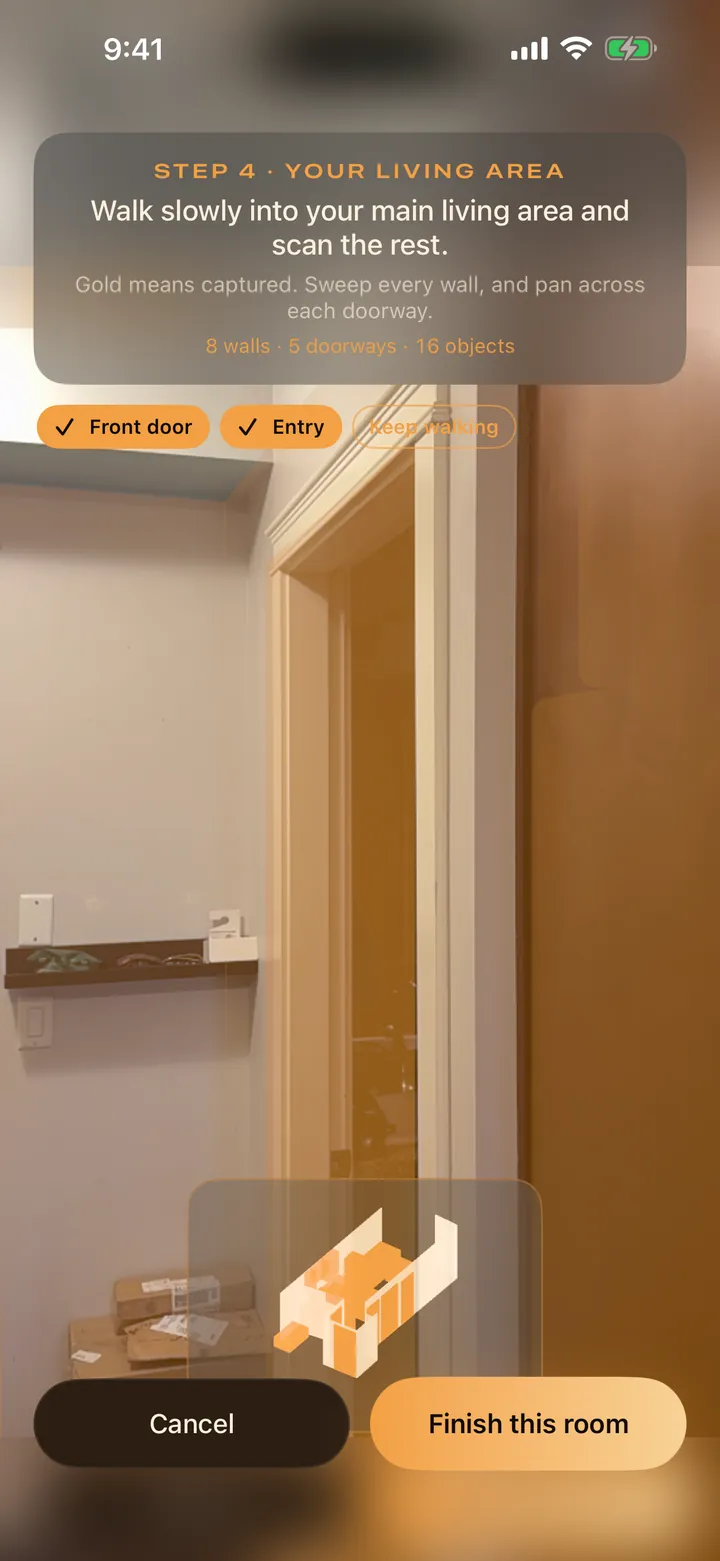
A checklist in your head is easy to lose halfway down a hallway. With the owner’s permission, you can scan the home on your phone and look at the layout again later.
SCAN THE HOME ON YOUR PHONE
Walk the home from the front door and see the flow, the layout findings and the Bagua map, with the owner's permission.
On the App Store and Google Play · iPhone, iPad and Android
What a scan reads at a viewing
- The flow path from the front door, drawn on the floor plan and shown as moving light in AR.
- A front door lined up with a window or back door, or facing a bathroom, a bedroom or a mirror.
- Furniture in the entry, narrow passages, crowded rooms and dead-end hallways.
- Whether there is a command position for each bed and desk, and the Bagua map over the plan.
- Not read: the building’s condition, ceiling beams, what sits behind walls, or the home’s value. Ask before scanning a home that is not yours; the scan stays on your phone.
Questions
What should I look for in a house for good Feng Shui?
Start with what you cannot change: what the front door faces, how the rooms connect, where the bedrooms are, and whether each bedroom has a solid wall for the bed with the door in view. Furniture and clutter matter less at a viewing, because they leave with the seller.
Is a house with stairs facing the front door bad Feng Shui?
Traditional Feng Shui treats stairs rising straight ahead of the front door as a concern, especially when they are close. It is a fixed feature, so buyers who care about it usually weigh it before an offer rather than after. Stairs to one side of the entrance are not read the same way.
Can I use Feng Shui instead of a home inspection?
No. Feng Shui is a traditional reading of a layout. A home inspection or survey reports on the condition of the building, and neither tells you what the home is worth.
Should I tell the seller or agent I am interested in Feng Shui?
That is your choice. Many agents are used to the question, and asking about the front door direction or the floor plan is ordinary.
Can I scan a home during a viewing?
Only with the owner's or listing agent's permission. A scan records the layout of someone else's home. In Feng Shui AR the scan stays on your phone and is not uploaded.
Sources and further reading
- Guo Pu (attributed), 葬書 Zangshu (The Book of Burial), Jin dynasty, 4th century
- Ole Bruun, An Introduction to Feng Shui, Cambridge University Press, 2008
- Michael Paton, Five Classics of Fengshui: Chinese Spiritual Geography in Historical and Environmental Perspective, Brill, 2013
Works on the tradition this page summarises. They are further reading, not endorsements of the app. How the app applies the rules: how Feng Shui AR reads a home.