
A bed on the door’s wall
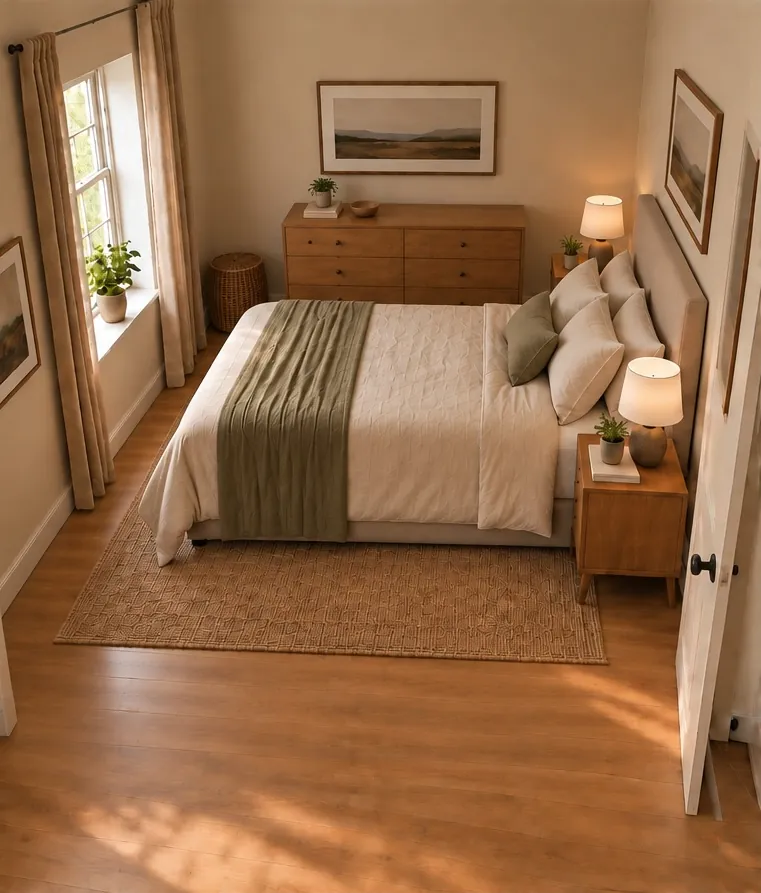 Before
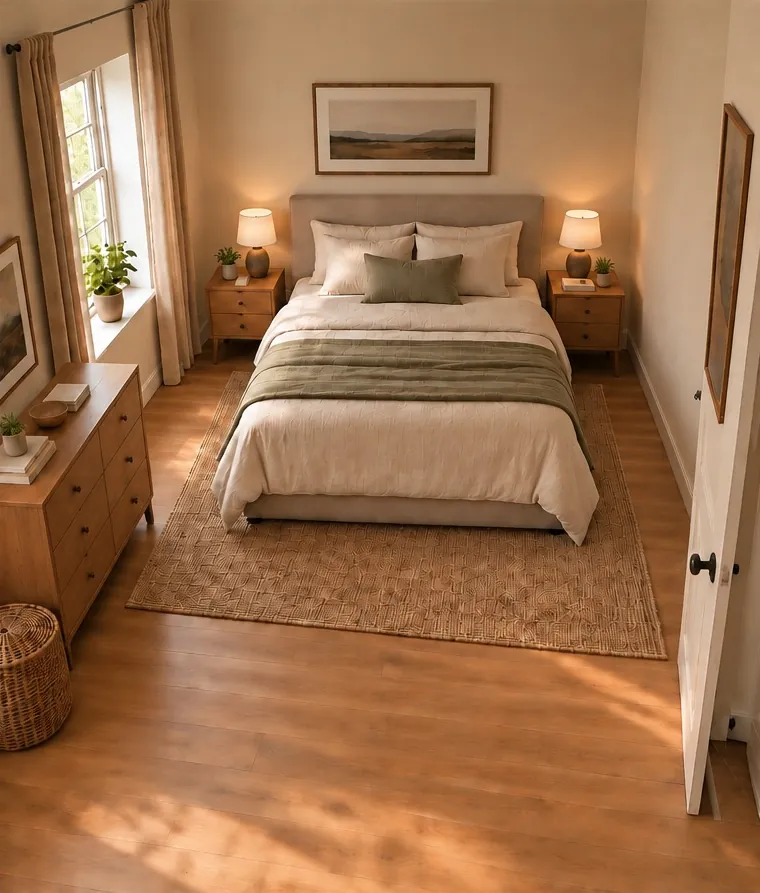 After
Rule: Command position
Before. The headboard is on the same wall as the door, so from the pillow the door is beside and behind you.
After. The bed moves to the far wall. The door is in view on a diagonal and the headboard has a solid wall behind it.
Reading the result
The verdict has three levels. In the command position means all three checks pass. Partly in command means you can see the door and are out of its line, but the headboard is pulled away from the wall or has a window behind it. Out of the command position means the door is behind you, or the bed lies in the door’s line.
The numbers behind it, so you can predict what it will say. Seen from the middle of the bed, the door counts as visible while it is no more than 100 degrees from the way you face, so a door off to one side still counts. The bed is in the door’s line when the door is ahead of you and its centre falls within the bed’s half-width plus 25 cm of the bed’s centre line. A window counts as behind you when the headboard’s centre is within 30 cm of the window’s edge. If no position is in command, the tool counts how many of the twelve wall spots are and offers one.
Why form-school Feng Shui cares about these three things, and what to do about each, is on the bedroom guide. This page sticks to the room in front of you.
Five rooms, run through the checker
The sample room is 3.6 by 4.2 metres, with a bed 1.5 metres wide (about a US queen or a UK king), a 0.8 m door and a 1.2 m window. Each layout below uses those settings, and the verdicts are the tool’s own.
A studio, or a door in the middle of the short wall
This is the UK box room and many studio flats: you come in through the middle of the short wall and the bed is the first thing you see. Set Near wall, Middle for the door and put the headboard on the far wall. Left, middle or right, the answer is the same: out of the command position, in the door’s line. At the left and right spots the bed misses the line by 3 cm.
Put the headboard on the right or left wall at the far end and it is in command. Four of the twelve spots pass with this door, all on the side walls.
The tool does not judge whether a bed should be on view from a studio’s front door; tradition would usually add a screen or a tall shelf between them.
Twin beds
A guest room or a child’s shared room with two beds side by side on the far wall, door at the near left. The tool places one bed at a time, so check each: far wall, Left is out of the command position (the door’s centre is 4 cm from the bed’s centre line); far wall, Right is in command. The tool draws a double, but the left bed here sits so squarely in the doorway that a single would be in line too. If one bed must stay in line, the usual advice is to give it a solid footboard or a bench between it and the door. With this door six of the twelve spots pass, but the far wall only has room for two beds at its left and right, and the left one fails, so in this room the pair cannot both be in command on that wall.
A door on the long wall
Common in American bedrooms off a hallway. Set the door to Left wall, Middle and the headboard opposite it, Right wall, Middle: out of the command position, the door straight ahead of your feet. Slide the same bed along the same wall to Far end and it is in command, about 1.2 m away. The tool counts six good spots for this door. One to avoid: Far wall, Left puts the bed in the doorway, and the tool says so.
The only free wall has the window
Door at the near left, window centred on the far wall, headboard under it: partly in command, because of the window. Slide the bed to the right end and it is in command. It clears only just, 97 cm from the window’s centre against a 90 cm limit, so a wider window would catch it. Move the door to the middle of the near wall as well and the centred bed becomes out of the command position: window behind and door in line. Then only the side walls pass. For what tradition says about sleeping under a window, see bed under a window.
A bed on the same wall as the door
Door at the near left, headboard on the near wall at the right: out of the command position, because the door is behind your shoulders. The first alternative the tool offers is the far wall, middle. Put the bed in the middle of the door wall and it also warns that the bed stands in the doorway. If the door wall really is the only option, bed facing the door and the bedroom guide cover the mirror and screen remedies.
Direction is a different question
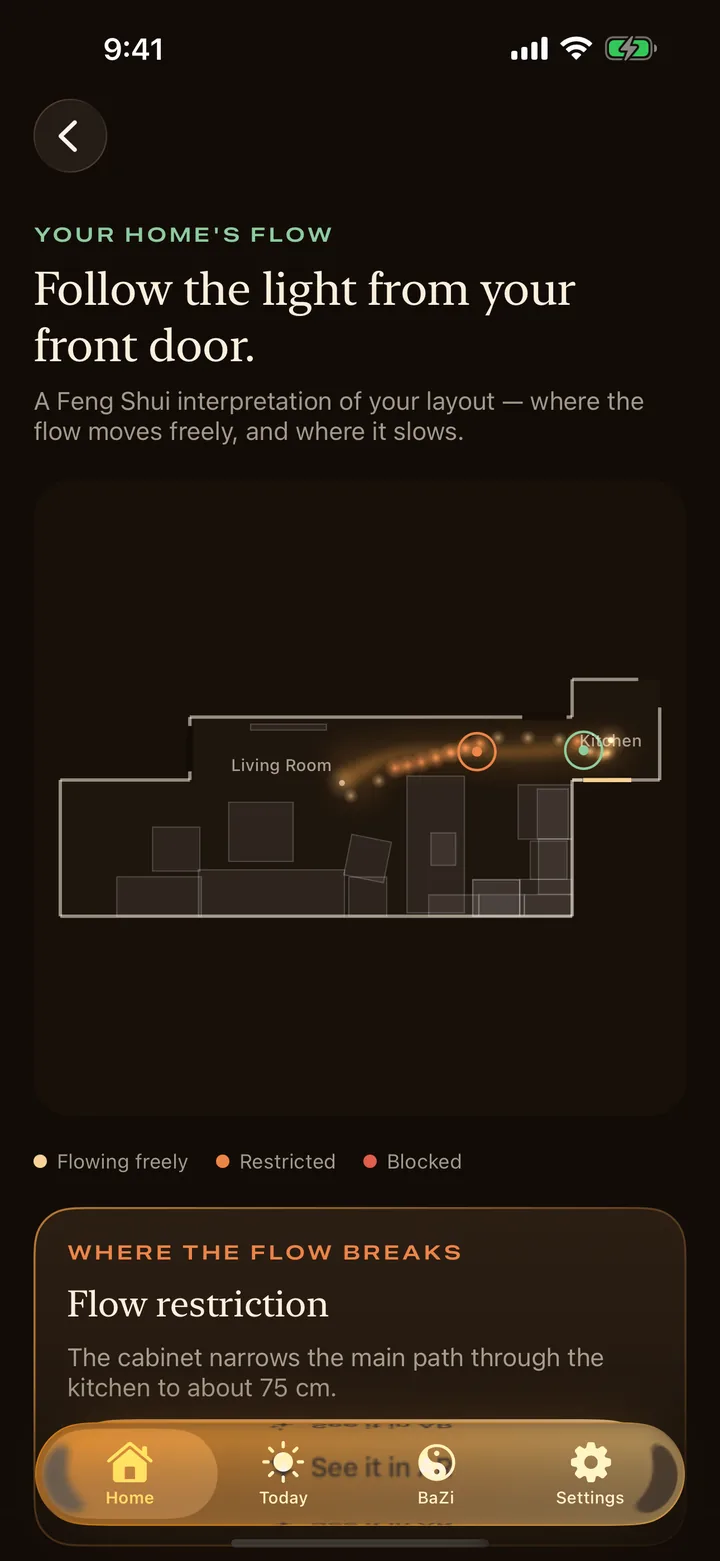
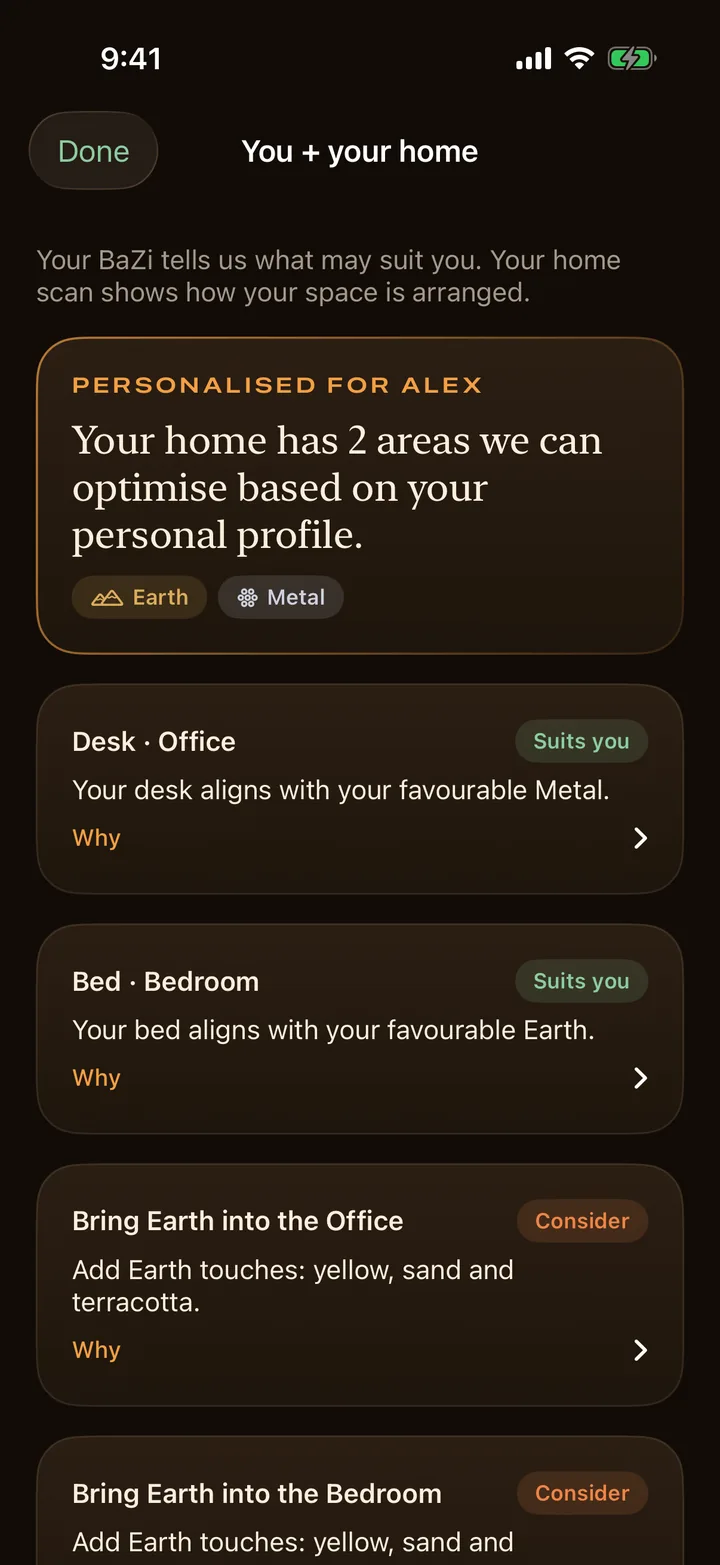
The checker ignores the compass. Which way your head should point depends on the school: the bed direction page gives the general answer, BaZi favorable directions reads it from a birth chart, and the Kua calculator uses Eight Mansions. They do not always agree. In the app, a compass heading from the scan and a BaZi profile let it read the bed separately from the command check.
A desk gets the same three checks with its own angles; the desk placement checker runs them.
What a scan checks that the tool cannot
- Your real room’s shape, including alcoves, angled walls and more than one door.
- The actual width of your bed and doorway, which decides whether the bed is in line.
- Windows where they really are, at their real width.
- Furniture corners aimed at the bed, and furniture narrowing the way in.
- With your BaZi chart and a compass heading, which sector the bed sits in and which way you face.
- Not read: ceiling beams over the bed and mirrors facing it.
Questions
What is the command position for a bed?
A position from which you can see the bedroom door without lying directly in line with it, with the headboard against a solid wall and no window behind it. Form-school Feng Shui treats it as the first decision in a bedroom.
Why does the tool say my bed is in line when it is off to one side?
The line is as wide as the bed plus 25 cm on each side, measured from the bed's centre. A 1.5 m bed is in line with any door whose centre is within a metre of its own, which is most of a narrow room.
Can I check two beds in the same room?
Yes, one at a time. Place the first bed, note the verdict, then move the headboard to the second bed's spot. Each bed is judged against the door on its own.
What if my bed fails only the window check?
It is rated partly in command. Tradition treats a window behind the headboard as weaker than a wall but better than a bed that cannot see the door. A solid headboard taller than the sill and a curtain closed at night are the usual remedies.
Is this the same check the app runs?
Yes, the same three checks with the same margins, applied to a simple rectangular room. The app applies them to the room you scan, with your bed's real size.
Sources and further reading
- Ole Bruun, An Introduction to Feng Shui, Cambridge University Press, 2008
- Michael Paton, Five Classics of Fengshui: Chinese Spiritual Geography in Historical and Environmental Perspective, Brill, 2013
Works on the tradition this page summarises. They are further reading, not endorsements of the app. How the app applies the rules: how Feng Shui AR reads a home.
Your room is not 3.6 by 4.2 metres, and your bed may not be 1.5 metres wide. Two of the layouts above turned on 3 cm, which is a measurement, not a guess.
SCAN YOUR BEDROOM
The tool uses a sample room. A scan checks your bed, in your room, to the centimetre.
On the App Store and Google Play · iPhone, iPad and Android