
How to use the converter
Pick a direction. For a Western date, enter the day as it appears on a birth certificate. For a Chinese date, enter the lunar year, month and day; the month list for each year includes its leap month, if it has one. The lunar year is numbered by the Western year in which it begins, so the year that starts at Lunar New Year in February 2026 is lunar year 2026.
The dates come from a table of the Chinese calendar from 1899 to 2100, computed for China time (UTC+8), which is how the calendar is defined. A birth late at night in the Americas can already be the next day in China; the converter uses the date as you enter it.
Why a January or February birthday is the hard case
The Chinese lunar year starts at Lunar New Year, on the second new moon after the winter solstice. That falls anywhere from 21 January to 20 February, so a birthday in those weeks can belong to the previous year. Someone born on 31 January 1977 was born before that year’s New Year on 18 February, so the zodiac counts them as a Fire Dragon of 1976, not a Fire Snake of 1977.
Feng Shui and BaZi use a different turning point: Li Chun, the start of spring, when the sun reaches 315 degrees of longitude, on 3, 4 or 5 February. In 1977 that was 4 February. So a birth between 4 and 18 February 1977 is a Snake to the zodiac’s lunar year but already 1977 to a BaZi chart and a Kua number. The converter tells you when your date falls in such a gap. The table of both dates for every year from 1930 to 2010 is on the element by birth year page.
Lunar months, leap months and day 30
A lunar month runs from one new moon to the next, so it has 29 or 30 days, and twelve of them make about 354 days. To stay in step with the seasons, a thirteenth, leap month is added about seven times in nineteen years. It repeats the number of the month before it: 2023 had a second month and then a leap second month.
Two things follow for birthdays. A birthday in a leap month has no exact match in most years, and most families keep it in the ordinary month of the same number. And a birthday on day 30 meets a 29-day month in some years; the usual practice is to keep it on day 29. The converter shows both conventions in its list of coming birthdays.
Writing the date in Chinese
The converter writes the date the way a Chinese calendar or a family record would: the year by its stem and branch, then the month, then the day. 31 January 1977 is 丙辰年 腊月十三, the 13th day of the 12th month of the Bing Chen year. The first month is called 正月 (Zheng Yue), the eleventh often 冬月 and the twelfth 腊月 (La Yue). Days one to ten take the prefix 初, so the first of the month is 初一.
What the lunar date is used for
In daily life, the lunar date sets the festivals and, in many families, the birthday that older relatives celebrate. In BaZi it is not used directly: the year and month pillars follow the solar terms, and the day pillar follows an unbroken cycle of days. A BaZi chart therefore needs your Western date, time and birthplace, not your lunar date, and so does the Kua number.
Common mistakes
- Starting the Chinese year on 1 January — a birth in January, and often in early February, belongs to the year before.
- Treating Lunar New Year and Li Chun as the same day — the zodiac year turns at the first, BaZi and Kua numbers at the second. Between the two, they disagree.
- Entering a lunar birthday into a BaZi calculator — BaZi calculators expect the Western date. Convert it first.
- Looking for the leap month every year — most years have none, and no month is leap in two years running.
What the app works out
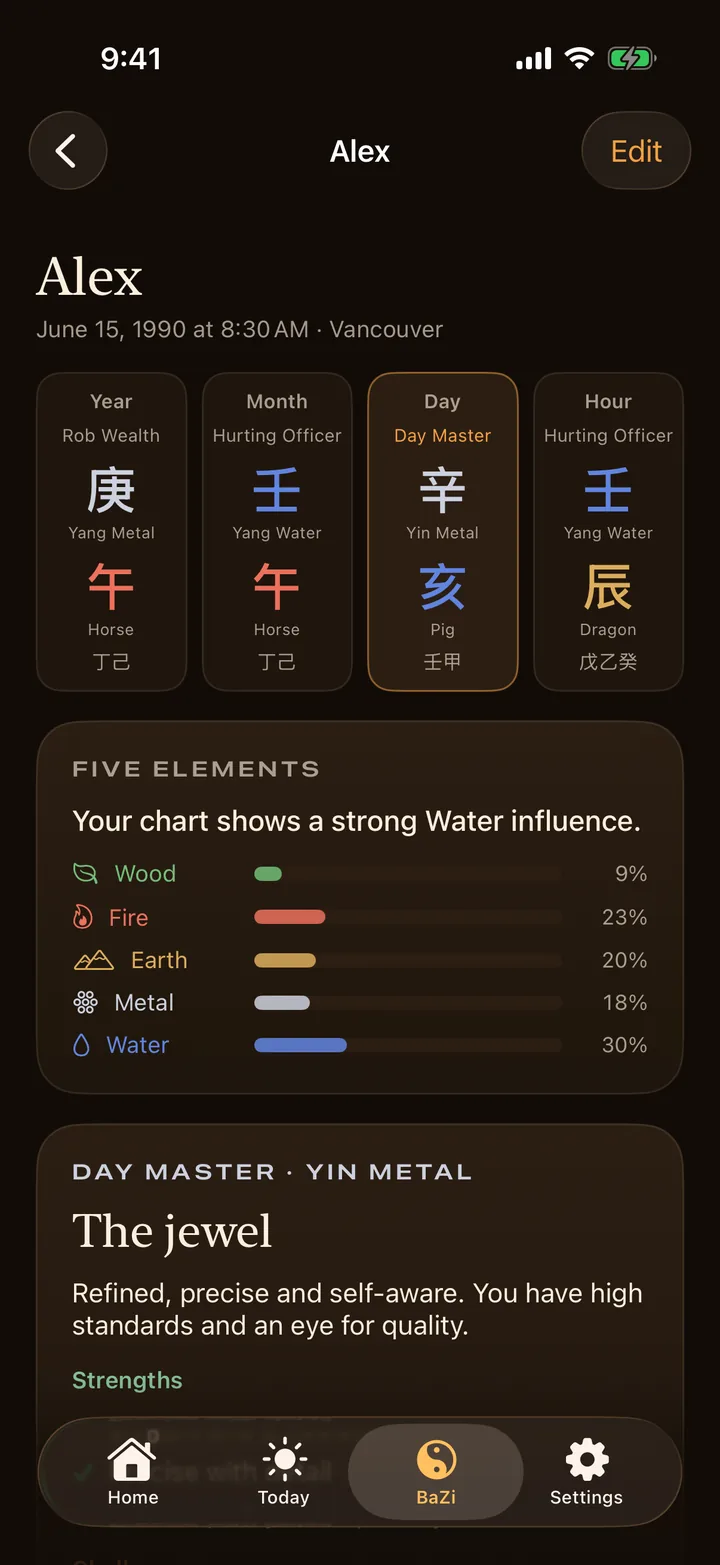
- Your Four Pillars from your Western birth date, time and place, with the year counted from Li Chun and the months from the solar terms.
- The Day Master, the five-element balance and the favourable elements that follow from it.
- In a scanned home: the rooms that have nothing of a favourable element, with colours and materials to add.
- Not used: your lunar date. The chart is worked out from the Western date, time and place.
Questions
How do I find my Chinese lunar birthday?
Enter your Western date of birth in the converter. It gives the lunar month and day you were born on and the Western dates that lunar birthday falls on in the coming years, because it moves by up to a month from year to year.
Why is my Chinese zodiac year different from my birth year?
The zodiac year begins at Lunar New Year, between 21 January and 20 February. If you were born in January or early February, before that year's New Year, you belong to the previous zodiac year.
Does Feng Shui use Lunar New Year?
No. Feng Shui and BaZi start the year at Li Chun, the start of spring on 3, 4 or 5 February. For births between Li Chun and a late Lunar New Year, the zodiac and a BaZi chart give different years.
What is a leap month?
An extra month added about seven times in nineteen years to keep the lunar calendar in line with the seasons. It repeats the number of the month before it. Someone born in a leap month usually celebrates in the ordinary month of the same number.
How far does the converter go?
From 1 January 1900 to 31 December 2100, both ways.
Sources and further reading
- Ole Bruun, An Introduction to Feng Shui, Cambridge University Press, 2008
- Michael Paton, Five Classics of Fengshui: Chinese Spiritual Geography in Historical and Environmental Perspective, Brill, 2013
Works on the tradition this page summarises. They are further reading, not endorsements of the app. How the app applies the rules: how Feng Shui AR reads a home.
SEE YOUR CHART
Enter a birth date, time and place and see your Day Master, your five-element balance and the elements your chart is said to favour.
On the App Store and Google Play · iPhone, iPad and Android