
Answer one: the element of your birth year
This is the element most zodiac charts give, as in "Metal Horse" or "Fire Rabbit". It comes from the heavenly stem of the year, and the stems run in a ten-year cycle, two years to each element. The last digit of the year tells you which:
| Year ends in | Element | Yin or yang |
|---|---|---|
| 0, 1 | Metal | 0 yang, 1 yin |
| 2, 3 | Water | 2 yang, 3 yin |
| 4, 5 | Wood | 4 yang, 5 yin |
| 6, 7 | Fire | 6 yang, 7 yin |
| 8, 9 | Earth | 8 yang, 9 yin |
Two cautions. The year does not begin on 1 January. In BaZi it turns at Li Chun, the start of spring around 4 February; popular zodiac charts often use Lunar New Year instead. Someone born on 25 January 1992 belongs to 1991 either way, so the year element is Metal, not the Water of 1992.
And the year element is not the animal’s element. Each of the twelve animals carries a fixed element of its own, the Horse Fire, the Rat Water. "Metal Horse" combines the year stem’s element with the animal, and the two can disagree. When a website says your element is Fire because you are a Horse, it is using the animal; when it says Metal, it is using the stem.
Answer two: your Day Master
A BaZi chart has four pillars, for the year, month, day and hour of birth, and each pillar is a stem over a branch. BaZi treats the stem of the day pillar as the person. It is called the Day Master, and it is the element a practitioner means by "you are a Yang Fire person" or "a Yin Water Day Master".
The day stems also run in a cycle of ten, but a cycle of days rather than years, so the Day Master changes every day and cannot be worked out from the year. You need the date, and you need the time if you were born late in the evening, because the BaZi day turns at 11 pm. The BaZi calculator finds it from your birth date, time and place. This is what people are usually after when they search for a "BaZi element calculator".
Why the two answers differ, and the others you will see
The year element is shared by everyone born in the same two-year stretch. The Day Master is shared by roughly one person in ten born that year. They describe different characters in the chart, so there is no reason for them to match, and usually they do not.
You may meet two more answers:
- The Kua element. Eight Mansions gives each person a Kua number, and each number belongs to an element: 1 Water, 3 and 4 Wood, 9 Fire, 2 and 8 Earth, 6 and 7 Metal. It comes from the birth year and sex, and is used for directions, not for colours.
- The Na Yin element. Some almanacs give each pair of years a poetic element, such as "Sea Metal" for 1984 and 1985. It is a separate tradition again and rarely used in home Feng Shui.
None of these is wrong. They answer different questions, and the trouble starts only when advice from one is applied with the reasoning of another.
How the five elements relate to you
Whatever your Day Master, the other four elements take fixed roles around it through the two cycles described under the five elements. For a Fire Day Master:
- Wood produces Fire, so it is the resource.
- Fire is the same element, so it is the peer.
- Earth is produced by Fire, so it is the output.
- Metal is controlled by Fire, so it is, traditionally, wealth.
- Water controls Fire.
Shift the list along the cycle for any other Day Master. These roles are what a BaZi reading weighs when it judges whether the chart leans too far one way.
What "favourable element" means
The element a chart is said to benefit from is called its favourable element, or useful god. It is found by judging whether the Day Master is strong or weak within the whole chart. A weak Day Master is said to want its resource and its own element. A strong one is said to want its output and the element it controls. The full method is set out under favorable elements.
So a strong Fire Day Master may well be told to favour Earth and Metal, and someone born in a Metal year may have nothing to do with Metal at all. This is the step most "what is my element" quizzes leave out, and it is the one that decides what goes into a room.
Using your element at home
The traditional application is small and specific. Take your favourable element, not your year element or your Day Master, and bring its colours, materials and shapes into the places where you spend long stretches: beside the bed, on the desk, near your seat in the living room. A lamp, a cushion, a plant or a picture frame is the scale intended. Each element also has compass directions said to suit it.
Layout comes before any of this. A bed in the command position matters more, in every school, than the colour of the bedding. And nothing here is a forecast: the elements describe a person in traditional terms, and adding a colour to a room is a choice about the room, not a promise about a life.
One birth, four answers
- A woman born on 15 June 1990 — By year she is Metal, because 1990 ends in 0. By zodiac animal she is a Horse, which is Fire. By Eight Mansions her Kua number works out to 5, read as 8, which is Earth. Her Day Master depends on the day and could be any of the ten stems.
- Her Day Master, once calculated — Suppose it comes out as Yin Wood. A BaZi reading would then weigh how much Water and Wood support it before naming a favourable element, which might be Water or might be Fire.
- What goes in her bedroom — The favourable element, whichever it is. Not Metal for the year, not Fire for the Horse.
- A female cousin born a week later — Same year, same animal, same Kua, and a different Day Master. Year-based methods treat them as identical; BaZi does not.
Common mistakes
- Using the zodiac animal’s element as your own — the animal’s element and the year stem’s element are different things, and neither is the Day Master.
- Decorating in your Day Master’s element — a strong Day Master is said to want its energy drawn off, not added to. Work from the favourable element.
- Changing the year on 1 January — a January birth belongs to the previous year in BaZi and in Eight Mansions.
- Mixing systems — the Kua element, the year element and the BaZi favourable element come from different methods. Pick one basis for what you add to a room.
Knowing your favourable element is half of it. The other half is knowing which of your rooms already has some of it and which has none, and that is a question about the home itself.
SEE YOUR CHART
Enter a birth date, time and place and see your Day Master, your five-element balance and the elements your chart is said to favour.
On the App Store and Google Play · iPhone, iPad and Android
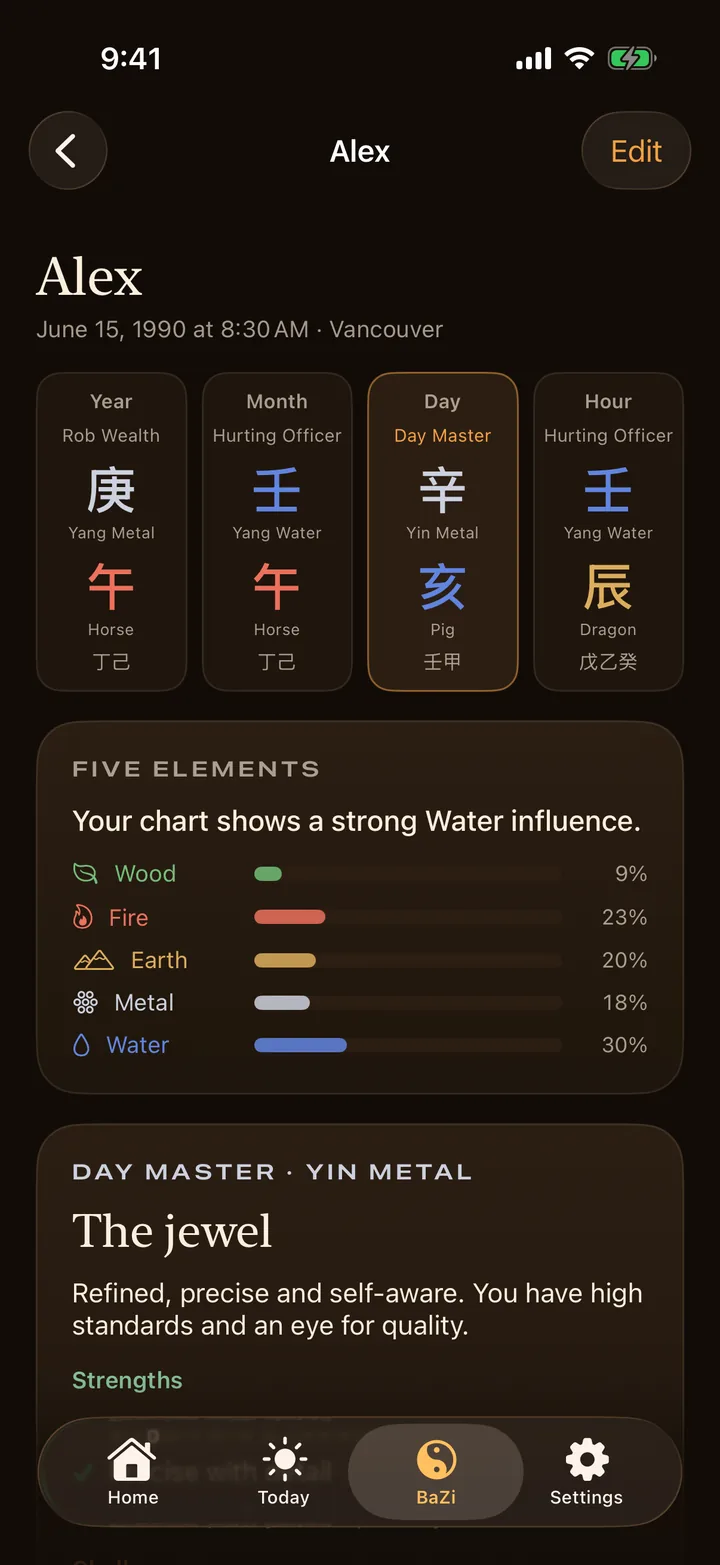
What the app works out
- Your Four Pillars from birth date, time and place, with the Day Master marked and a profile of it.
- The balance of the five elements across the chart, and the favourable elements that follow from the Day Master’s strength.
- In a scanned home: which living rooms, bedrooms and offices have nothing of a favourable element, with colours and materials to add.
- With a compass heading: the sector each bed and desk sits in and the direction you face, against your favourable elements.
- Not used: the Kua element or the Na Yin element. The app also does not read the colours already on your walls.
Questions
What is my Feng Shui element by birth year?
Look at the last digit of the year you were born, counting the year from early February: 0 and 1 are Metal, 2 and 3 Water, 4 and 5 Wood, 6 and 7 Fire, 8 and 9 Earth. If you were born in January or before about 4 February, use the previous year.
How do I find my BaZi element?
Your BaZi element is your Day Master, the heavenly stem of the day you were born. It cannot be worked out from the year, so it needs a calculator that builds the Four Pillars from your date, and your time if you were born after about 11 pm.
Which element should I use for my home?
Practitioners generally use the favourable element of your BaZi chart rather than your year element or your Day Master. It is found from the strength of the Day Master within the whole chart.
Is my element the same as my Chinese zodiac element?
Usually not. The zodiac animal has a fixed element, the year stem gives another, and the Day Master gives a third. They come from different parts of the chart.
Do I need my birth time?
Not for the year element. For the Day Master it matters only if you were born late in the evening, because the BaZi day turns at 11 pm. For the full chart and its favourable elements, the hour pillar adds information, but a three-pillar reading is still possible without it.
Sources and further reading
- Xu Sheng (compiler, after Xu Ziping), 淵海子平 Yuanhai Ziping, Song dynasty
- Ole Bruun, An Introduction to Feng Shui, Cambridge University Press, 2008
Works on the tradition this page summarises. They are further reading, not endorsements of the app. How the app applies the rules: how Feng Shui AR reads a home.