
How to find a missing corner on a floor plan
Black Hat practice, the most common source of the idea, uses the front door to set the grid:
- Draw the smallest rectangle that contains the whole outline of the home.
- Turn the plan so the wall with the front door is at the bottom.
- Split the rectangle into three by three. Each square is one area of the Bagua map.
- Look for a square that lies mostly outside the walls, over a garden, a neighbour’s flat or a light well.
Which area goes missing depends only on where the gap sits relative to the front door. A notch at the far left takes out Wealth; at the far right, Love & Relationships; in the middle of the back wall, Fame. Two homes with the same shape can therefore have different missing areas. The floor plan guide covers how to trace the outline before you lay the grid.
Missing or extension: the half rule
Not every bump makes a missing corner. The common rule of thumb compares the part that sticks out with the length of the wall it sticks out from.
- Less than half the wall: the bump is an extension, read as a strength for the area it sits in. The rectangle is drawn without it.
- More than half the wall: the bump is the main body of the home, the rectangle includes it, and the gap beside it is a missing area.
Practitioners also look at how much of each square is filled. A square with most of its floor inside is read as present; one with less than half inside is read as missing. Homes near the boundary are where teachers disagree most, so treat a borderline case as borderline.
What counts as inside the walls
This is the question that changes the answer most, and there is no single rule.
- Attached garage. Many teachers count it if it shares the roof and a wall; others leave it out because no one lives in it.
- Balconies and porches. Usually left out, unless enclosed and heated.
- Conservatories. Often counted when used as a room all year.
- Flats. Use your own unit’s walls, not the building’s.
Decide once and apply it to the whole plan. Counting the garage for one area and not for another is the most common way two readings of the same home disagree.
What people do outside
The classic remedy is to mark the point where the two outside walls would meet if the rectangle were complete, shown as the dot in the drawing. People put something there that stands up and stays: a tree or a large planted pot, a garden light, a heavy stone, or a stretch of fence or hedge that closes the L. The idea is to "finish" the shape. Some go further and pave or plant the whole missing square so it reads as part of the home.
This only applies where the missing area is your land. In a terraced house or a flat it is usually someone else’s garden or the street, and the inside remedies are used instead.
What people do inside
- A mirror on the wall that faces the missing area. The traditional reading is that it opens the wall. It is the most common indoor remedy and the most debated; keep it from facing the front door or a bed, which other rules caution against.
- The same area, room by room. Black Hat practice also lays a small Bagua over each room from its own door. If Love & Relationships is missing from the home, the far-right corner of the bedroom is where teachers suggest giving attention. The love corner and wealth corner pages describe what usually goes there.
- Colour and element. Each area has an element and colours; adding them in the rooms nearest the gap is a lighter version of the same idea.
None of these remedies has been tested. The plain reading of an L-shaped plan is that some rooms sit further from the middle of the home than others.
Missing northwest, southwest or wealth corner by compass
Searches for a missing northwest or southwest corner come from the compass method, which aligns the grid to north instead of the door. A gap in the northwest is a missing northwest whatever the door does. In the version that maps the Bagua areas onto directions, Wealth sits in the southeast, Love & Relationships in the southwest and Helpful People & Travel in the northwest.
The trigrams add older associations. The northwest belongs to Qian, linked with the father or head of the household and with the metal element; the southwest to Kun, linked with the mother and with earth; the southeast to Xun, linked with wood. That is why the suggested remedies differ by direction: metal objects and round shapes near a missing northwest, ceramics, stone and low square shapes near a missing southwest, healthy plants near a missing southeast.
Eight Mansions reads a missing sector against the household’s favourable directions, and Flying Stars looks at which stars fall outside the walls in the current year. The same house can be missing Wealth by the front door and missing west by compass. Pick one method and stay with it.
Four homes with a gap
- A bungalow with a back garden in the notch of the L — The far-right square is about a third filled, so Love & Relationships reads as missing. A small tree at the corner point, where the two back walls would meet, is the usual suggestion.
- A semi with the garage on the left — Counted, the home is a rectangle; left out, Wealth is missing. Teachers split here. If the garage is used as a workshop or utility room, most would count it.
- A flat with a recessed balcony at the far left — The balcony is outside, so Wealth is under half filled. There is no outside corner to mark, so the left corner of the living room is where attention usually goes.
- A house with a bay at the back — The bay is well under half the back wall, so it is an extension of Fame, not a missing area beside it.
Common mistakes
- Drawing the rectangle around the garden — the grid covers the building, not the plot.
- Counting the garage for one area but not another — choose once for the whole plan.
- Calling every notch a missing corner — a bump under half the wall is an extension.
- Mixing the front-door and compass grids — a gap can be "Wealth" by one and "west" by the other. They are different readings.
- Deciding against a home on this alone — it is one tradition’s reading of the outline. The other signs of good or bad Feng Shui in a house come from the layout, and a viewing has more fixed things to check; see the home-buying checklist.
What a scan shows about a missing corner
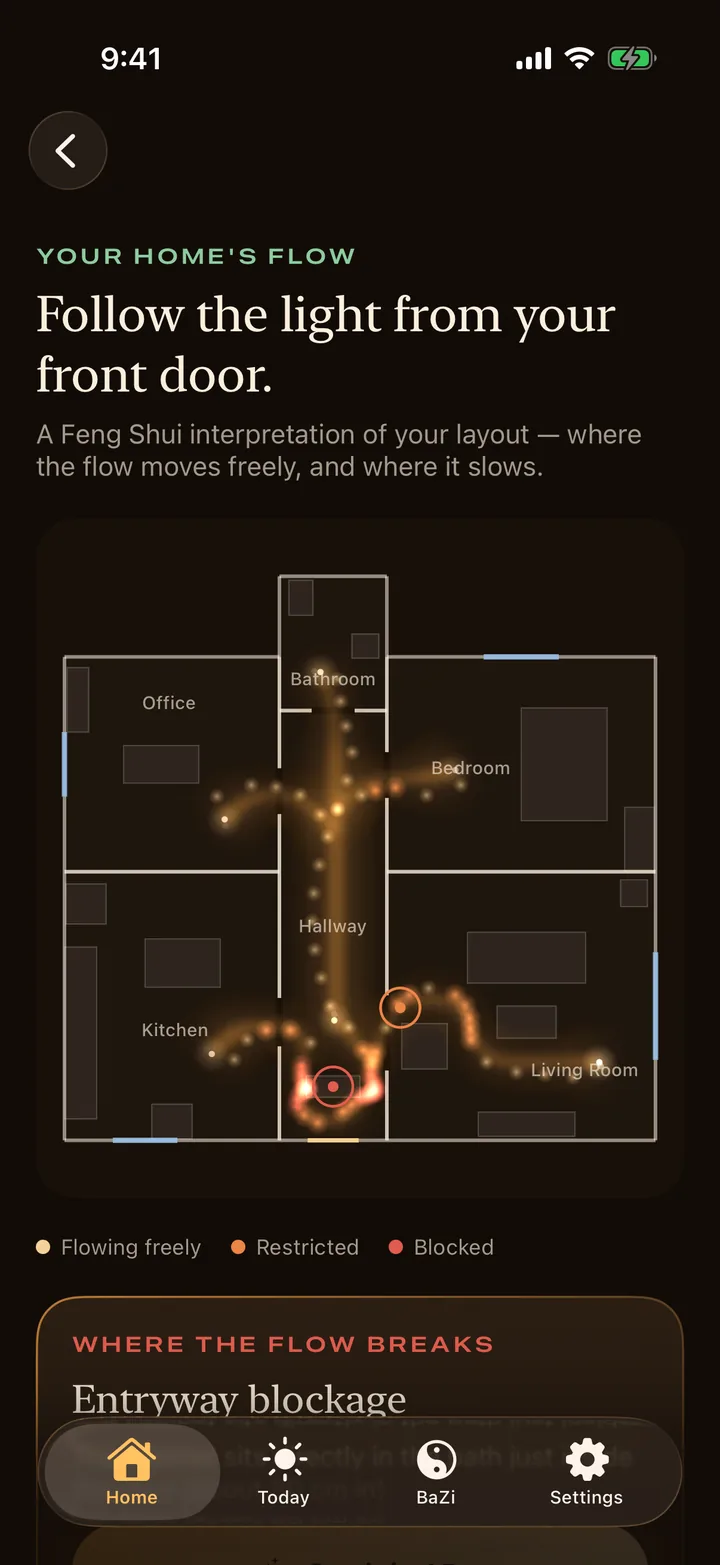
- Draws your floor plan from a walk through the home that starts at the front door, with walls straightened and corners closed.
- Lays the Bagua over the whole plan from the front door and lists any area with less than half of its square on your floor as missing, with a one-line note on the traditional remedies.
- A compass view sets eight sectors around the middle of the home from the heading recorded during the scan. The missing list belongs to the front-door view.
- The Flow score out of 100 is built from how you move through the home and where the furniture stands, so a missing corner does not lower it.
- Multi-floor homes: the Bagua is read on the floor with the front door, the way most teachers apply it.
- Not read: the half-wall extension rule (every scanned room widens the grid), garages and balconies unless you scan them as rooms, and anything in the garden.
Questions
Is an L-shaped house bad Feng Shui?
Not in itself. Most teachers see it as a home with one area to attend to, not as a reason to avoid it. Whether a corner is missing at all depends on how big the gap is, and the usual remedies are small.
How do you fix a missing corner in Feng Shui?
Traditionally, outside, you mark the point where the walls would meet with a plant, tree, light or stone. Inside, the usual suggestions are a mirror on the wall facing the gap, or attention to the same area in each room's own Bagua. These are symbolic gestures, not tested fixes.
What is the traditional cure for a missing northwest corner?
By the compass method the northwest is linked with the metal element, the head of the household and helpful people. The suggestions people follow are metal objects, round shapes, or grey and white in the rooms nearest the gap, and a light or stone at the outside corner if the land is yours.
What about a missing southwest corner?
The southwest is linked with earth and with relationships. Ceramics, stone and low square shapes near the gap are the usual suggestions, along with giving attention to the far-right corner of the bedroom by the front-door method.
Does an attached garage count?
Teachers differ. Many count it when it shares the roof and a wall with the home, especially if it is used as a room. Others leave it out. Make the choice once and apply it to the whole plan.
What if I rent a flat with a missing corner?
Use the inside remedies. Lay the Bagua over each room from its own door and give the matching corner some attention, which needs no changes to the building.
Sources and further reading
- Guo Pu (attributed), 葬書 Zangshu (The Book of Burial), Jin dynasty, 4th century
- Ole Bruun, An Introduction to Feng Shui, Cambridge University Press, 2008
- Michael Paton, Five Classics of Fengshui: Chinese Spiritual Geography in Historical and Environmental Perspective, Brill, 2013
Works on the tradition this page summarises. They are further reading, not endorsements of the app. How the app applies the rules: how Feng Shui AR reads a home.
Whether a corner is missing comes down to where the walls really are and how much of each square they cover, and that is hard to judge from a listing sketch.
SEE YOUR HOME'S BAGUA
Walk your home from the front door and see the Bagua laid over the real plan, with any area under half its square listed as missing.
On the App Store and Google Play · iPhone, iPad and Android